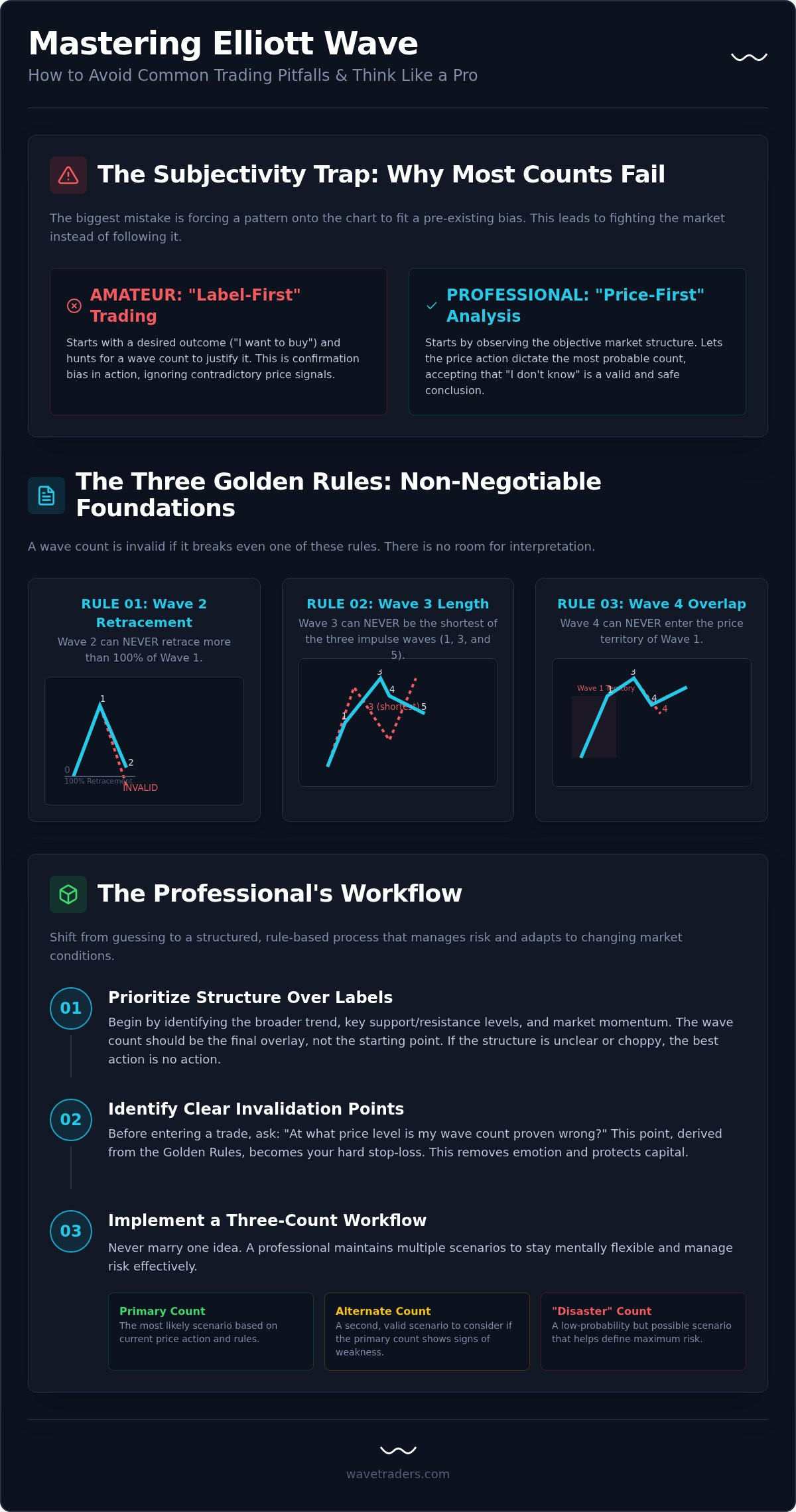
Why does your Elliott Wave count always seem to change the moment you enter a trade? It’s a frustrating experience that many traders face. You identify what looks like a textbook impulse pattern, place your order, and then watch the market immediately invalidate your logic. If you’ve ever felt like wave labeling is purely subjective or found yourself making common Elliott Wave trading mistakes during a volatile Wave 4 correction, you’re likely falling into the same traps as most retail participants.
We understand that the transition from theory to live execution is where most people struggle. To find consistency, you must move beyond surface-level patterns and address the psychological hurdles that turn a precise methodology into a guessing game. Mastering this approach isn’t about predicting every minor wiggle in price. It’s about building a rule-based framework that tells you exactly when your thesis is wrong and when it’s time to step aside.
In this guide, we’ll break down the core rules that cannot be broken and the specific errors that lead to inaccurate counts. You’ll learn how to identify clear invalidation points and sync your analysis with the professional mindset required for a funded trader program. By the end, you’ll have the tools to stop guessing and start trading with the quiet confidence of a seasoned practitioner who knows exactly where they stand in the market cycle.
Many traders approach the charts with a preconceived bias, looking for a way to validate their existing trade ideas. This leads to the “Count-Drunk” phenomenon, where an analyst forces a specific pattern onto price action that simply isn’t there. It’s one of the most common Elliott Wave trading mistakes we see in the community. Instead of observing price objectively, they try to bend the Elliott Wave Principle to fit their narrative.
Professional analysis requires a clear distinction between counting waves and identifying market structure. Wave counts are the specific details, but structure is the broader foundation. If you prioritize the label over the actual trend, you’ll find yourself fighting the tape. The 2026 market environment, characterized by rapid shifts in crypto regulations and high-frequency volatility, requires a flexible “Alternate Count” mindset. You can’t afford to be married to a single count when the underlying structure changes.
The danger of “Label-First” trading is that it ignores “Price-First” observation. Labeling a chart is easy; interpreting what the price is actually doing takes discipline. When you start with the label, you’re projecting your desires onto the market. When you start with price, you’re letting the market tell you its story. This subtle shift in perspective is what separates the amateur from the seasoned practitioner.
Traders often hunt for a specific wave to justify a trade they’ve already decided to take. This is a classic psychological trap. If you’re looking for a reason to buy, your brain will find a way to label a correction as a finished Wave 2. Confirmation bias in technical analysis is the primary killer of capital; it’s the act of seeking out information that supports your trade while ignoring evidence that contradicts it. To combat this, you must approach every timeframe with a blank slate. Don’t look for what you want to see; look for what is actually present. By starting your analysis from scratch, you remove the emotional weight of previous opinions.
Recognizing when a market is in a messy corrective phase is just as important as identifying a clean trend. Not every price move fits into a standard 1-2-3-4-5 impulse. Sometimes, the market is simply noise. A profitable analyst knows that “I don’t know” is a valid and often lucrative conclusion. You don’t have to have a count for every instrument at every moment. Our Elliott Wave School emphasizes pattern non-recognition. Learning when to stay on the sidelines because the structure is unclear is often more valuable than knowing when to enter. This discipline keeps you out of low-probability trades that drain your account.
Success in wave analysis starts with absolute adherence to the core tenets of the theory. There’s no room for “close enough” when you’re dealing with the three golden rules. If price action violates a rule, the count is objectively wrong. Attempting to trade an invalid structure is one of the most common Elliott Wave trading mistakes, often leading to catastrophic stop-outs because the anticipated reversal or continuation simply won’t happen.
A technical error doesn’t just ruin one trade; it creates a ripple effect. Because waves are fractals, a mislabeled sub-wave on a 5-minute chart cascades upward, eventually invalidating the entire daily count. This is why many traders stay on the wrong side of the market for weeks. They’re tracking a five-wave impulse that was technically disqualified days ago. To prevent these mathematical errors, professional traders often use an Elliott Wave Calculator to ensure Fibonacci relationships and price levels align with the rules before they commit any capital.
A frequent point of confusion involves the length of Wave 3. Clarifying the rule: Wave 3 doesn’t have to be the longest, but it cannot be the shortest of the three impulse waves (1, 3, and 5). Many traders prematurely label a move as Wave 3, only to realize it’s shorter than Wave 1. If Wave 5 then exceeds the length of Wave 3, the entire count fails. This often happens when a trader mistakes a “Truncated 5th” for a standard move. If your Wave 3 looks small, it’s likely that you’re actually looking at a complex correction or a different wave degree entirely. You can’t force a short move to be an impulsive Wave 3 just because you want the trend to continue.
In a standard impulsive move, Wave 4 must never enter the price territory of Wave 1. This is a hard boundary. Beginners often struggle here when they encounter a Leading Diagonal, which is a specific motive pattern where overlap is permitted. Mislabeling a diagonal as a standard impulse leads to incorrect expectations about the speed and depth of the subsequent move. An overlap in a standard impulse immediately shifts the count to a correction. When this happens, you must stop looking for an extension and start preparing for a deeper retracement. If you find yourself consistently missing these nuances, exploring our Elliott Wave School can provide the structured training needed to avoid these technical traps.
Advanced analysts often move past basic rule-breaking only to fall into the “Fractal Problem.” This occurs when you lose track of which degree a specific wave belongs to. You might mistakenly label a Minuette sub-wave as a Minute wave, creating a count that is mathematically impossible within the higher timeframe. This confusion is among the most common Elliott Wave trading mistakes because it obscures the true maturity of a trend; it leads traders to believe a move is finished when it has only just begun.
In the 2026 crypto markets, these errors are amplified. High-frequency trading and algorithmic execution often create price spikes that look impulsive but lack the time duration to qualify as a major degree change. Traditional time-degree expectations are frequently distorted here. A move may look like a primary impulse in price, but if it only lasts a fraction of the time required by classical theory, it’s likely a sub-wave or a corrective “B” wave. Maintaining a sense of proportion is vital for keeping your analysis grounded in reality.
To maintain clarity, you must develop a systematic way to separate degrees. We recommend using a consistent color-coding and notation system across all charts. For example, use blue for Minute degrees and red for Minuette. This visual separation prevents you from accidentally combining sub-waves into a larger structure where they don’t belong. It’s a simple fix that eliminates a massive amount of analytical noise.
The “Anchor Wave” technique is another essential tool. By locking in the primary degree on a higher timeframe, like the daily or weekly, you create a structural boundary for your lower timeframe analysis. Without this anchor, it’s easy to get lost in the intraday wiggles. We often see these errors in EUR/USD Elliott Wave analysis, where traders try to count five waves on a 15-minute chart without realizing the entire move is just one leg of a larger corrective pattern. Always zoom out before you zoom in.
Time is just as important as price. The Rule of Alternation suggests that if Wave 2 was a sharp, fast retracement, Wave 4 should be a sideways, slow, and complex correction. If your Wave 4 is too short in duration, it’s often not a Wave 4 at all. It might be a “Wave 1 of a higher degree” instead, signaling that the trend is about to accelerate. Professional analysts look for harmony between price movement and time duration to confirm a valid cycle.
Using Fibonacci time zones helps project potential completion windows. If price reaches a target but hasn’t consumed enough time, the pattern is likely incomplete. When these proportions are out of sync, it’s a warning sign that your current count needs an alternate perspective. By respecting the time it takes for a market to breathe, you avoid the trap of entering a trade before the correction has truly matured.
Being a skilled analyst is about historical accuracy and pattern recognition. Being a successful trader is about risk management and timing. Many people fall into common Elliott Wave trading mistakes by assuming a clear count is an automatic green light for an entry. A count is merely a map of probability; it doesn’t account for the execution slippage or psychological pressure of a live position. You can be 100% right about the wave degree and still lose money if your entry logic is flawed.
High-probability execution often requires Fibonacci confluence. For example, a Wave 3 label should ideally reach at least a 1.618 extension of Wave 1. If price stalls before this level, your impulsive count might actually be a corrective “ABC” structure in disguise. Ignoring these mathematical filters is a frequent error. Another trap is relabeling fatigue. This happens when a trader repeatedly changes their labels to justify staying in a losing trade. It’s a dangerous form of common Elliott Wave trading mistakes where the analyst tries to “negotiate” with the market instead of accepting a stop-out.
A wave label is a hypothesis, not a signal. To bridge the gap, you need a “Trigger.” This is a specific price action event or momentum shift that confirms the wave turn. Beginners often attempt to catch the exact bottom of Wave 2, which is one of the most dangerous entry points. It’s often better to wait for a sub-wave breakout to confirm that the trend has actually shifted. Developing this level of entry discipline is a core requirement for those in our Funded Trader Program, where managing prop capital requires moving beyond guesswork and into a repeatable, rule-based workflow.
Every valid trade must have a clear exit strategy based on the theory’s hard rules. It’s vital to distinguish between a standard stop loss and an invalidation point. A stop loss is a capital protection tool based on your account size. The invalidation point is the price level where the primary count becomes mathematically impossible. If Wave 4 overlaps Wave 1 in a standard impulse, your count is dead. Professional traders place their stops at these logical boundaries. If the market hits that level, your thesis is proven wrong, and there’s no reason to remain in the trade. Placing stops based on these structural limits ensures you aren’t shaken out by minor volatility while your broader count remains intact.
Moving from a casual observer to a professional trader requires a shift from guessing to a repeatable analytical workflow. If you approach the charts with a casual mindset, the market will treat you like a casual participant. By formalizing your approach, you eliminate the common Elliott Wave trading mistakes that stem from emotional reactivity. A professional process isn’t about being right every time. It’s about having a plan for when you’re right, when you’re wrong, and when the market does something completely unexpected.
One of the most effective ways to manage uncertainty is the “Three Count” Rule. Instead of marrying yourself to a single perspective, you should always maintain three distinct counts: the Primary, the Alternate, and the “Disaster” count. The Primary count is your highest probability path. The Alternate is what happens if your sub-wave labeling is slightly off. The Disaster count is the level where your entire thesis is invalidated. This approach forces you to acknowledge uncertainty without feeling anxious about it. It keeps you objective when price action begins to deviate from your initial expectations.
Practicing this level of pattern recognition across different asset classes builds the necessary “chart eye” for success. For instance, leveraging real-time Silver Elliott Wave analysis allows you to see how commodity cycles often provide cleaner, more elongated structures than volatile FX pairs. Seeing these patterns play out in commodities can help you identify similar structures in other markets. Professional tools and community support further reduce emotional errors by providing a sounding board for your ideas.
A disciplined workflow starts at the top and works its way down. Follow these three steps to ensure your count is grounded in reality:
Lone-wolf trading often leads to “bias loops.” When you’re the only person looking at your charts, it’s easy to ignore common Elliott Wave trading mistakes because you’ve convinced yourself your count is perfect. Peer review fixes this. By sharing your counts with a community of experienced practitioners, you get immediate feedback that highlights potential rule breaks or overlooked alternates.
Our FX and Digital Currency services provide this real-time validation, helping you stay aligned with the broader market structure. If you’re ready to move beyond self-taught errors and start trading with professional-grade precision, you can apply for Wavetraders Membership to track the markets alongside our expert team.
Success with the Elliott Wave Principle isn’t about finding a crystal ball; it’s about developing a disciplined, repeatable workflow. We’ve examined how technical rule breaks and psychological traps lead to inaccurate counts and avoidable losses. Correcting these common Elliott Wave trading mistakes requires a fundamental shift toward price-first observation and a strict adherence to invalidation points. When you move beyond the “count-drunk” phase and start respecting wave degrees and time proportions, you gain the quiet confidence needed to navigate volatile cycles.
At Wavetraders, we’ve spent over 20 years refining this methodology to help practitioners achieve professional standards. We provide real-time analysis across FX, Crypto, and Commodities, alongside specialized support for those in our Funded Trader Program. Trading doesn’t have to be a solitary struggle against subjective labels. By joining a community that values methodical analysis over hype, you can sharpen your pattern recognition and protect your capital. Master the Markets with Expert Elliott Wave Analysis at Wavetraders. Let’s track the next major market move together with precision and clarity.
Elliott Wave is profitable when treated as a probability framework rather than a crystal ball. Subjectivity usually arises when traders ignore the hard rules to fit a personal bias. In 2026, the key to consistency is maintaining alternate counts that account for rapid shifts in market sentiment. By following a methodical process, you transform the methodology from a guessing game into a structured analytical tool that identifies high-probability setups across all degrees.
The most common Elliott Wave trading mistakes involve forcing a specific pattern onto messy price action. Beginners often feel they must have a label for every minor wiggle on the chart. This “count-drunk” behavior leads to trading in low-probability environments where the structure is unclear. Successful practitioners know that pattern non-recognition is a vital skill. If the market doesn’t offer a clean impulsive or corrective structure, the most profitable decision is often to wait for more data.
In a standard impulsive structure, Wave 4 must never enter the price territory of Wave 1. This rule remains absolute, even in the highly volatile cryptocurrency markets. However, overlap is permitted within diagonal patterns, which often appear as leading diagonals in Wave 1 or ending diagonals in Wave 5. Misidentifying a standard impulse when price has clearly overlapped is a technical error that invalidates your primary count and requires an immediate shift to a corrective or diagonal interpretation.
You can identify a failing count by establishing clear invalidation points before you enter a trade. These are specific price levels where the current wave labels become mathematically impossible based on the core rules. If price breaches these levels, your thesis is objectively proven wrong. Using a rule-based workflow ensures you aren’t guessing about when to exit. This discipline is essential for anyone aiming to pass a Funded Trader Program where capital preservation is the highest priority.
Wave 3 is considered the heart of the cycle because it represents the strongest and most impulsive part of the trend. It’s characterized by high momentum, significant volume, and a clear lack of deep retracements. In most cases, it’s the longest wave, though the rule only dictates it cannot be the shortest. Traders prioritize Wave 3 because it offers the most explosive price movement in the shortest amount of time, providing the best risk-to-reward opportunities in the market.
Fibonacci is essential for validating wave structures and identifying high-probability entry and exit zones. While the wave labels describe the pattern, Fibonacci ratios provide the mathematical evidence that a specific wave is complete. For example, a Wave 3 often reaches a 1.618 extension of Wave 1, while a Wave 2 typically retraces between 50% and 61.8% of the previous move. Without these ratios, your analysis lacks the precision required for professional-grade execution and risk management.
Hard rules are non-negotiable laws that, if broken, immediately invalidate a wave count. Examples include Wave 2 never retracing more than 100% of Wave 1 and Wave 3 never being the shortest wave. Guidelines, such as the Rule of Alternation or Fibonacci targets, are strong tendencies that the market usually follows but doesn’t strictly require. Understanding the difference helps you avoid common Elliott Wave trading mistakes where you might discard a valid count based on a guideline violation rather than a rule break.
The Rule of Alternation suggests that the market rarely repeats the same type of correction twice in a row within the same impulsive cycle. If Wave 2 was a sharp and fast retracement, you should expect Wave 4 to be a sideways and complex move. This guideline helps you avoid mislabeling a complex correction as a new trend. By anticipating a change in the complexity and depth of sub-waves, you can maintain a more accurate and realistic count during volatile phases.
DISCLAIMER
Any reviews, news, analysis, prices or other information contained on our website is provided as general market commentary and delivered electronically through a distribution channel to larger number of clients, therefore does not constitute investment advice or investment research. We are not trading advisors. Most of our work is for educational purposes only, with information based on Elliott Wave theory in real time. Trading forex, futures, options, stocks, cryptocurrenices or any another trading market carries a high level of risk, and may not be suitable for all investors.
The possibility exists that you could lose some or all of your initial investment; therefore you should not invest money that you cannot afford to lose. Our website and the information that we provide should not be relied upon as a substitute for extensive independent research before making your investment decisions. In no event will we be liable for any loss or damage on your account in connection with, the use of our products. For any real cash investments you have to contact your financial advisor.
Any information or material contained on our website is owned by Val Global d.o.o.. Reproduction is prohibited without Val Global d.o.o. prior license in writing.
By continuing to use the site, you agree to the use of cookies. Learn more.
The cookie settings on this website are set to "allow cookies" to give you the best browsing experience possible. If you continue to use this website without changing your cookie settings or you click "Accept" below then you are consenting to this.