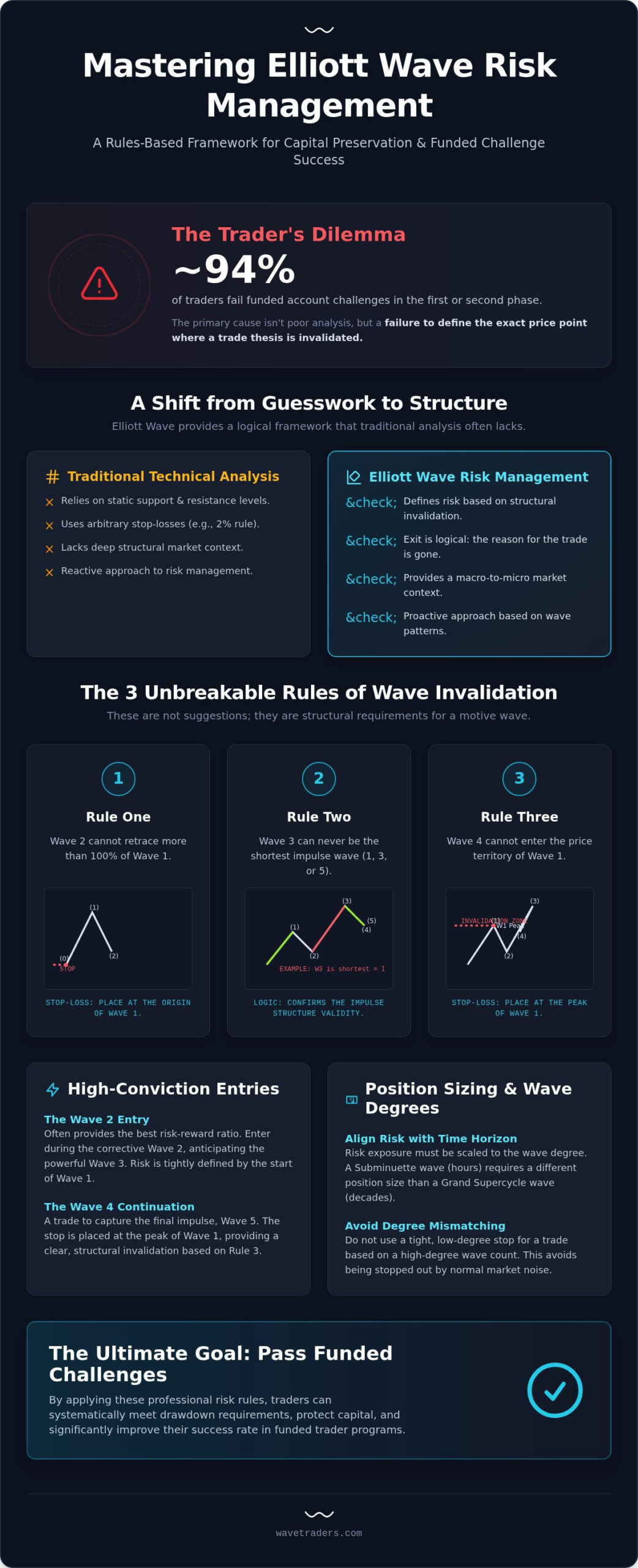
Did you know that nearly 94% of traders fail to complete the first or second phase of a funded account challenge? Most of these losses aren’t caused by a lack of technical knowledge; they’re caused by a failure to define the exact price point where a trade thesis dies. In the fast-moving 2026 markets, where the S&P 500 has recently crossed the 7800 mark, relying on a vague idea of a wave count isn’t enough. Professional Elliott Wave risk management is about moving beyond the emotional stress of volatile corrective patterns and replacing it with a cold, rules-based framework for capital preservation.
It’s frustrating to watch a massive Wave 3 move unfold from the sidelines after being stopped out by a minor retracement. We’ve all been there, and we understand the analysis paralysis that sets in when complex corrections refuse to provide a clear signal. This article will show you how to master the invalidation rules that turn theory into a precise, professional-grade risk management system. You’ll learn how to gain confidence in your position sizing based on wave degrees and set stops that respect the actual market structure. We’ll walk through the specific strategies needed to protect your capital and improve your performance for funded trader challenges.
Most traders approach the market by asking where the price is headed. While forecasting is a significant part of the Elliott Wave Principle, the real power of the methodology lies in its ability to tell you exactly where your thesis is wrong. Traditional technical analysis often relies on static support and resistance levels. These levels can be useful, but they lack the structural context that Elliott Wave risk management provides. A support level in a corrective Wave 2 has a completely different risk profile than a temporary stall during a parabolic Wave 3.
The 1235 wave cycle highlights that volatility isn’t distributed evenly across a trend. It tends to cluster in specific areas, such as the heart of a third wave or the terminal stages of a fifth wave. By recognizing these patterns, you can anticipate periods of high volatility before they occur. This allows for a proactive approach to risk rather than a reactive one. Instead of wondering why a support level failed, you’ll understand that the market structure had already shifted into a new phase that rendered that level irrelevant.
Standard risk management often uses a “one size fits all” approach, like a 2% stop-loss from the entry price. This is often arbitrary and doesn’t account for the market’s current structure. In contrast, trade invalidation is based on the specific price level that proves your wave count is structurally incorrect. If a price moves into a territory that violates a core rule, the pattern is dead. Invalidation is the bedrock of professional wave trading because it provides a non-negotiable exit point based on logic rather than emotion. This shift in perspective ensures you aren’t just setting stops to avoid losing money; you’re setting them because the reason for being in the trade no longer exists.
Every wave exists within a larger context. Understanding how an Elliott Wave degree explained dictates your time horizon is vital for capital protection. A Grand Supercycle wave represents a multi-decade trend, while a Subminuette might last only hours. Risk exposure should be scaled according to these degrees. You wouldn’t use the same position size for a micro-scalp as you would for a long-term investment. Degree mismatching happens when a trader applies a tight stop from a lower degree to a trade based on a much higher degree. This usually results in being stopped out by normal market noise before the larger move even begins. Effective Elliott Wave risk management requires aligning your position size with the volatility typical of the specific degree you’re trading.
In the previous section, we discussed how invalidation serves as the logical basis for exits. To apply this effectively, you must internalize the three unbreakable rules of the motive wave. These aren’t suggestions; they’re structural requirements. If a price move violates any of these, your current wave count is objectively incorrect. This certainty is exactly what makes Elliott Wave risk management so effective compared to guessing with arbitrary percentages or wide, emotional stops.
The first rule is that Wave 2 can never retrace more than 100% of Wave 1. The second rule states that Wave 3 can never be the shortest of the three motive waves (Waves 1, 3, and 5). Finally, Rule 3 dictates that Wave 4 cannot enter the price territory of Wave 1 in a standard impulse wave. While specific exceptions like leading or ending diagonals exist, these three rules form the hard boundaries for the majority of your trades. They provide the “if-this-then-that” logic required for professional-grade execution.
Applying these rules to your trading platform is a straightforward process. For a Wave 2 entry, your stop-loss belongs exactly at the start of Wave 1. If price hits that level, the bullish or bearish thesis is dead, and there’s no reason to stay in the position. For Wave 4 trades, the peak of Wave 1 provides a clear line in the sand. If price overlaps into that territory, the impulse pattern is invalidated. If you’re navigating complex sideways markets, understanding the Elliott Wave triangle rules helps you identify where a consolidation should end and where a breakout becomes a failure.
It’s vital to distinguish between a rule and a guideline. Rules define the must-haves for a pattern to exist, which makes them perfect for stop-loss placement. Guidelines, like the Rule of Alternation, suggest what is likely to happen. For instance, if Wave 2 was a sharp zigzag, Wave 4 is likely to be a complex sideways correction. While guidelines help you manage emotional risk and set realistic profit targets, they shouldn’t be used as hard invalidation points. They inform your risk budget by telling you when a pattern is looking “stretched” or “mature.”
Channeling techniques also fall into the guideline category. By drawing trendlines connecting the ends of Waves 1 and 3, and then projecting a parallel line from the end of Wave 2, you can spot over-extended zones. This doesn’t mean you exit immediately, but it signals that the risk of a reversal is increasing. If you’re looking to refine these entries further, the Elliott Wave School provides a structured environment to practice these rules on live charts before risking capital.
Effective Elliott Wave risk management requires a nuanced understanding of where you are in the cycle. Each wave has a distinct personality and, consequently, a unique risk profile. While the three unbreakable rules provide the structural boundaries, these wave-specific strategies help you optimize your capital allocation based on the current market environment. Navigating an aggressive impulse wave requires a different mindset than surviving a choppy correction.
Wave 3 is often called the momentum phase. The primary risk here is the “momentum trap,” where traders chase the price after it has already gone parabolic. Because Wave 3 is frequently the longest move, it’s tempting to enter late with a wide stop. Instead, risk management in a third wave should focus on trailing stops to capture the extension. Conversely, Wave 5 represents exhaustion. As the trend matures, you should reduce position sizes and tighten stops significantly. Divergence on momentum oscillators often signals that the end is near, making smaller exposure mandatory for capital protection.
Wave 2 is often the most rewarding entry point for disciplined traders. Because it typically retraces a large portion of Wave 1, you can enter with a very tight stop just below the origin of the trend. Fibonacci levels such as the 61.8% and 78.6% retracements are common zones where these corrections terminate. This high-conviction setup is particularly valuable for traders attempting a funded trader challenge. The tight stop allows for larger position sizes without violating strict drawdown limits. Managing the deep retrace is the primary challenge here; you must trust your invalidation level rather than exiting early out of fear.
Wave 4 is notoriously difficult to trade because it’s often a complex, sideways correction. Many traders give back their Wave 3 profits by over-trading during this choppy phase. If a correction lasts significantly longer than the preceding waves, consider using a time-stop. This means exiting the trade simply because the anticipated move hasn’t happened within a reasonable window. You can see how this looks in practice by reviewing Elliott Wave forex trading examples, which often highlight the frustratingly slow nature of Wave 4 in currency pairs. Corrective A-B-C structures are similarly high-risk because they lack a sustained trend, requiring a more defensive posture.
Standard position size calculators are often insufficient for the nuanced requirements of wave theory. Most basic tools only ask for a stop-loss in pips or a fixed percentage of your account. While this works for simple support and resistance, it fails to account for the structural invalidation points that define a wave count. Professional Elliott Wave risk management requires a tool that understands the mathematical relationship between wave degrees and Fibonacci projections. If your stop-loss isn’t placed at the exact point where your count is invalidated, you’re essentially guessing.
When you use the Elliott Wave Calculator, you begin by inputting the specific price coordinates of your Wave 1 and Wave 2. The tool then calculates the potential extension for Wave 3, which frequently targets the 161.8% Fibonacci level. By knowing the precise price where Wave 2 is invalidated, the calculator determines the exact position size needed to keep your risk within your pre-defined parameters. This ensures that even if you’re wrong, the loss is controlled and mathematically consistent with your overall plan.
The “1% Rule” remains a gold standard in this framework. Wave theory provides a powerful edge, but it doesn’t excuse over-leveraging. Because market interpretation can be subjective, keeping your risk per trade to 1% or less of your account balance is vital for long-term survival. This conservative approach allows you to withstand the occasional “failed impulsive move” without damaging your capital base or your psychological state.
Trading becomes dangerously emotional when a trader begins to “hope” that a count is still valid despite evidence to the contrary. A specialized calculator removes this subjective bias by providing an objective set of data. The Wavetraders Elliott Wave Calculator automates Fibonacci projection math, which ensures your targets and stops are based on structural probability rather than wishful thinking. This allows you to balance your potential reward-to-risk ratio against a realistic assessment of the pattern’s likelihood of completion. If the R-multiple isn’t high enough to justify the risk, the calculator makes that clear before you ever click “buy.”
Markets are fractal, meaning smaller wave patterns exist within larger ones. A “Fractal Risk” approach involves aligning a lower-degree count, such as a 15-minute chart, with the direction of a higher-degree trend like the Daily chart. If the Daily trend is in a powerful Wave 3, you can hunt for Wave 2 entries on the 15-minute timeframe to achieve a massive R-multiple. As the price moves in your favor, use wave sub-divisions to scale out of the position and lock in profits. This disciplined strategy prevents the over-trading trap that many traders fall into during long, sideways corrections where the trend is less clear.
Passing a prop firm evaluation requires more than a high win rate; it requires a deep understanding of how to protect a virtual account under strict constraints. Most challenges impose a maximum daily drawdown of 5% and a total drawdown of 10%. When you’re operating within these tight boundaries, Elliott Wave risk management becomes your most valuable asset. It allows you to align your trades with the market’s natural rhythm while maintaining a mathematically sound exit strategy. With research indicating that approximately 94% of traders fail to complete the evaluation phases, the margin for error is non-existent.
Wave 2 entries are often considered the holy grail for these challenges. Because a Wave 2 can never retrace more than 100% of Wave 1, you can place a stop-loss that is structurally justified rather than arbitrary. This precision allows you to calculate a position size that stays well within the 5% daily limit while still targeting the 8% to 12% profit goals required for funding. Conversely, trading a maturing Wave 5 is often too risky for a challenge. The potential for a sharp, corrective reversal is high, and a single mistake can trigger a daily drawdown violation. Managing trailing drawdowns during a powerful Wave 3 extension is another critical skill. As price moves parabolic, many prop firms adjust your drawdown limit based on your peak account balance. Using wave sub-divisions to trail your stop ensures that you lock in gains without leaving your account vulnerable to a deep Wave 4 retracement.
Success in a high-stakes environment depends on knowing exactly where you’re wrong before you enter. By adapting your wave counts to meet 5% daily loss limits, you remove the emotional weight of the trade. If your invalidation point is hit, the count is dead, and you preserve the capital needed for the next setup. This psychological clarity is what separates funded traders from the majority who fail. Some firms now offer unlimited time to pass their challenges, which removes the pressure of deadlines and allows you to wait for high-probability Wave 2 setups. This patient approach is essential when the S&P 500 is trading at historic levels above 7800 and volatility is elevated.
Mastering these principles takes practice. Transitioning from theory to live execution is best achieved through the Elliott Wave School, where you can refine your risk rules under the guidance of experienced practitioners. Our real-time FX and Digital Currency services provide the daily analysis needed to validate your own counts and risk levels. Join the Wavetraders community today to start tracking the markets together and turn Elliott Wave theory into a professional trading career.
Transitioning from a retail mindset to a professional one requires shifting your focus from “where is the price going” to “where is my count invalidated.” We’ve explored how the three unbreakable rules provide the structural foundation for this shift. By using the specialized Elliott Wave Calculator and targeting high-probability Wave 2 entries, you can navigate the 2026 markets with a level of precision that traditional technical analysis simply cannot match. This rules-based approach is the key to surviving the volatility of complex corrective patterns and meeting the strict drawdown requirements of modern prop firm challenges.
Effective Elliott Wave risk management is a skill that is developed through consistent practice and expert guidance. Since 2003, we’ve helped traders move beyond the ambiguity of wave counts to build robust, capital-protecting systems. Whether you’re aiming to pass a Funded Trader Program or refine your own personal portfolio, the right education makes all the difference. You don’t have to track these complex cycles alone. Apply for the Wavetraders Elliott Wave School and Master Risk Management today to gain access to our proprietary tools and a community of dedicated practitioners. We look forward to helping you achieve a new level of confidence in your trading journey.
The most critical rule is that Wave 2 can never retrace more than 100% of Wave 1. This provides an absolute price level for trade invalidation. If the price moves beyond the origin of the first wave, the impulsive thesis is objectively dead. Using this rule as a hard stop-loss is the cornerstone of professional Elliott Wave risk management, as it removes the guesswork often found in traditional support and resistance strategies.
You set a stop-loss by identifying the structural point where your wave count becomes mathematically impossible. For a Wave 2 entry, the stop belongs exactly at the start of Wave 1. If you are trading a Wave 4 retracement, the stop is typically placed at the peak of Wave 1. These levels aren’t arbitrary percentages; they are defined by the market’s own structural requirements, ensuring you only exit when the logic for the trade is gone.
Yes, Elliott Wave principles are highly effective in crypto markets due to their high emotional volatility and fractal nature. Bitcoin and other digital assets often follow very clear impulse and corrective cycles that respect Fibonacci levels. Applying Elliott Wave risk management in crypto helps you avoid chasing parabolic Wave 3 moves and protects your capital during the deep, sharp retracements that are characteristic of Wave 2 corrections in the digital asset class.
Beginners often struggle because they attempt to force a count to fit their personal bias rather than letting the market reveal its structure. This subjectivity leads to ignoring the core rules of invalidation. Additionally, many newer traders fail to account for multiple timeframes, leading to a degree mismatch where they apply tight stops to high-degree trends. Mastering the methodology requires the discipline to accept when a count is invalidated and move to the next setup.
The Elliott Wave Calculator removes the emotional burden of manual calculations by automating Fibonacci projection math. By inputting the price coordinates of Waves 1 and 2, you can instantly see the projected targets for Wave 3. The tool calculates the exact position size required to maintain your risk parameters based on the invalidation point. This ensures every trade is sized correctly relative to your account balance and the specific market structure you are trading.
A high-probability setup, such as an entry at the end of Wave 2, often provides a risk-reward ratio of 1:3 or significantly higher. Because Wave 3 is frequently the longest and most powerful move, the potential upside is large compared to the tight stop-loss at the origin of Wave 1. While some traders aim for even higher ratios, maintaining a consistent 1:3 profile allows you to remain profitable even if your win rate is below 50%.
Managing risk during complex corrections requires patience and a reduction in position size. Corrective waves are often choppy and lack the clear direction of impulse moves, which increases the likelihood of being stopped out by market noise. Using time-stops is a common strategy; if the correction lasts significantly longer than expected without a breakout, it is often safer to exit. You should wait for a clear impulsive start before increasing your exposure again.
It is exceptionally well-suited for funded trader challenges because it focuses on protecting against the max daily drawdown limits. Since prop firms have strict 5% or 10% loss rules, having a non-negotiable invalidation point is vital. The precision of a Wave 2 entry allows you to maximize your position size while staying within these tight risk parameters. This systematic approach helps you avoid the emotional trading that causes approximately 94% of challenge participants to fail.
DISCLAIMER
Any reviews, news, analysis, prices or other information contained on our website is provided as general market commentary and delivered electronically through a distribution channel to larger number of clients, therefore does not constitute investment advice or investment research. We are not trading advisors. Most of our work is for educational purposes only, with information based on Elliott Wave theory in real time. Trading forex, futures, options, stocks, cryptocurrenices or any another trading market carries a high level of risk, and may not be suitable for all investors.
The possibility exists that you could lose some or all of your initial investment; therefore you should not invest money that you cannot afford to lose. Our website and the information that we provide should not be relied upon as a substitute for extensive independent research before making your investment decisions. In no event will we be liable for any loss or damage on your account in connection with, the use of our products. For any real cash investments you have to contact your financial advisor.
Any information or material contained on our website is owned by Val Global d.o.o.. Reproduction is prohibited without Val Global d.o.o. prior license in writing.
By continuing to use the site, you agree to the use of cookies. Learn more.
The cookie settings on this website are set to "allow cookies" to give you the best browsing experience possible. If you continue to use this website without changing your cookie settings or you click "Accept" below then you are consenting to this.