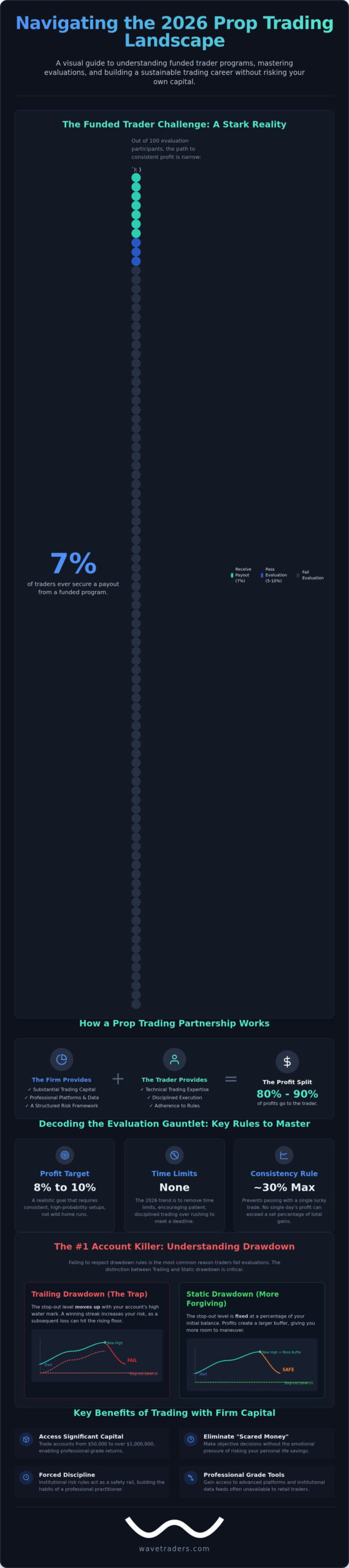
Only about 7% of traders who enter a funded trader program ever actually secure a payout. While the prospect of managing $50,000 to $1 million in institutional capital is enticing, the reality often involves handling a minefield of strict drawdown rules and consistency requirements that can feel designed to trigger failure. You’ve likely felt the weight of trying to grow a personal account where every loss feels like a setback to your long-term financial security. It’s a high-pressure environment that demands more than just a basic understanding of price action.
We understand that the gap between a talented technician and a funded professional is often just a matter of capital and structure. This guide provides a clear roadmap for the 2026 prop trading environment, especially following the recent elimination of the Pattern Day Trader rule. You’ll discover how to apply disciplined technical analysis to meet firm-specific targets and keep 80% to 90% of your profits. We’ll walk through the current evaluation standards and show you how to build a sustainable trading career without risking your own life savings.
A funded trader program is essentially a commercial arrangement where a firm provides the capital while the trader provides the technical expertise. Historically, this model was reserved for proprietary trading desks on Wall Street, where professional analysts worked in physical offices. Today, the digital shift has opened these doors to retail traders globally. The firm absorbs the actual financial loss if a trade goes wrong. In return, the trader assumes the responsibility of following strict risk parameters and performance benchmarks. It’s a symbiotic relationship where the firm provides the fuel and the trader provides the navigation.
In 2026, this model has become even more relevant for the average market participant. The elimination of the Pattern Day Trader (PDT) rule in April 2026 fundamentally changed how US equity traders view capital requirements. While it’s now easier to day trade with smaller personal accounts, a funded trader program remains the most viable way to access significant buying power. It solves the primary barrier for most talented technicians: the lack of a large enough account to make professional-grade returns meaningful without over-leveraging personal savings.
Most partnerships operate on a profit-split basis that rewards consistent performance. While these splits vary by firm, they typically range from 70% to 90% in favor of the trader. It’s vital to distinguish between your account balance and your actual buying power. A firm might grant you a $100,000 account, but your actual loss limit or drawdown might only be $5,000. Firms are willing to fund retail traders because they can leverage the collective success of many individuals while hedging their own risk through simulated environments or institutional liquidity pools. They aren’t just looking for lucky winners; they’re looking for disciplined executors of a proven strategy.
Securing a position in a funded trader program begins with the evaluation phase. This is a high-stakes simulation where you must prove your ability to generate returns while adhering to strict risk management protocols. Statistically, the hurdle is significant. Industry data indicates that only 5% to 10% of traders successfully pass their initial evaluation. This low success rate isn’t necessarily due to a lack of market knowledge. Instead, it’s often the result of failing to respect the firm’s specific mathematical constraints. These platforms are increasingly under the lens of oversight, as evidenced by a recent FINRA regulatory notice regarding the intersection of social trading and proprietary platforms.
Most firms set a profit target between 8% and 10% of the starting balance. While this gain might seem achievable, the psychological pressure of a test can lead to over-leveraging. A significant trend in 2026 is the removal of strict time limits. Many firms now allow traders to take as long as they need to hit their goals. This shift encourages a patient approach, which is essential for those using technical analysis to find high-probability setups. Rushing to hit a target usually forces trades in low-volatility environments, which is a primary cause of account failure. Firms also implement consistency rules to ensure you aren’t just lucky. For instance, Apex Trader Funding typically applies a 30% consistency rule, meaning no single day can account for more than 30% of your total profit during the evaluation.
The trailing drawdown is the most common reason for evaluation failure. Unlike a static drawdown that stays fixed at a certain level, a trailing drawdown moves upward as your account balance reaches new peaks. If you have a $50,000 account with a $2,500 trailing drawdown and you grow the account to $52,000, your liquidation point moves to $49,500. It doesn’t move back down if you experience a losing streak. This creates a shrinking buffer that requires precise trade management. Managing this risk is easier when you have a clear framework, such as the methodology taught at Wavetraders, to identify exactly where a trend might be exhausted. To avoid hitting daily loss limits, you must calculate your position size based on the volatility of the specific wave you’re trading, ensuring that a single stop-out doesn’t end your challenge.
Most participants in a funded trader program face a fundamental choice between two distinct paths. The evaluation model is the most common route. It requires you to pass a one-step or two-step challenge on a demo account before receiving access to live capital. This path offers the lowest barrier to entry in terms of cost. For example, a 50K evaluation account typically carries a fee between $150 and $200. The trade-off is the performance requirement. You must hit a profit target while adhering to strict drawdown rules. If you fail, you lose your entry fee and must start over.
The instant funding model allows you to skip the “test” phase entirely. You pay a higher upfront fee to begin trading a live account immediately. While this removes the hurdle of an evaluation, the initial capital provided is often smaller, and the profit splits might start lower than the 90% offered by evaluation-based firms. Scaling is the primary reward for consistency in both models. Firms like FTMO or Funding Traders often scale successful accounts up to $2 million. They also increase profit splits as milestones are reached, sometimes allowing traders to keep 100% of their gains through specific add-on structures.
Technical analysts who rely on objective frameworks often find the evaluation path more rewarding. It provides a low-risk environment to refine execution under institutional-style constraints. For many practitioners, the question of is an elliott wave subscription worth it is answered when they use professional analysis to navigate these challenges. Having a clear view of market structure helps you identify high-probability entries that align with the firm’s profit targets. This model rewards those who can demonstrate a repeatable process rather than those seeking quick, unverified gains. Choosing the right funded trader program for technical analysts means finding a platform whose rules align with the patience and precision that structural analysis demands.
Instant funding is best suited for traders who have already mastered their emotional discipline and have a proven strategy. You avoid the psychological pressure of a “pass or fail” challenge, but you still face liquidation if you hit your maximum drawdown. This model is ideal if you have the capital to cover the higher entry fees and want to begin withdrawing profits as soon as possible. Some firms allow your first payout as early as 14 days after your first trade. However, it’s a tool for the experienced professional. If you’re still refining your technical approach, the evaluation path is usually the more responsible choice.
Most traders fail evaluations because they trade market noise rather than market structure. A funded trader program is essentially a test of your ability to identify high-probability environments while managing strict risk parameters. Elliott Wave theory provides an objective, rule-based framework that aligns perfectly with these institutional constraints. It isn’t about guessing the next move. It’s about recognizing repeatable patterns in price action that signal where the market is in its larger cycle. When you trade with a map, you stop reacting to every tick and start anticipating the next structural shift.
Wave 3 and Wave C are the primary profit engines for passing a challenge. Wave 3 is typically the longest and most powerful part of a trend. By identifying the start of a Wave 3, you position yourself to capture the momentum needed to hit profit targets quickly. This velocity is crucial for staying ahead of trailing drawdowns. Similarly, Wave C often completes a corrective phase with a clear, tradable move. Learning how to pass funded trader challenge requirements involves filtering out the “middle of the move” noise and focusing exclusively on these high-conviction terminal points.
Impulse waves provide the momentum necessary for meeting the consistency rules found in many programs. These waves move sharply in the direction of the main trend, allowing you to build a profit buffer without enduring long periods of stagnation. In contrast, corrective waves are often choppy and overlapping. This is the “danger zone” where most traders hit their daily loss limits. By recognizing a correction early, you can choose to stay on the sidelines. This disciplined approach ensures that your capital is only at risk during high-momentum periods where the probability of a successful outcome is highest.
Precise invalidation levels are the greatest gift Wave Theory offers to those in a funded trader program. If a Wave 2 retraces more than the start of Wave 1, your count is objectively wrong. This provides a logical, non-emotional place to set your stop-loss. By pairing these levels with Fibonacci extensions, you can target Risk-to-Reward (R:R) ratios of 1:3 or better. This mathematical edge is the core of Elliott Wave risk management. It prevents the over-trading that leads to account liquidation. When you have a clear pattern to wait for, the urge to “force” a trade disappears. You become a patient hunter of specific market geometries.
Ready to master these patterns and secure your capital? Explore the professional analysis and tools at Wavetraders to start your journey toward funded status.
Securing capital is the final piece of the puzzle for most technical analysts. At Wavetraders, we’ve spent more than 20 years refining the bridge between retail theory and institutional execution. We recognize that even the most accurate wave counts are limited by the size of the account they’re traded on. That’s why we’ve established a direct partnership that integrates our educational resources with a professional funded trader program. This collaboration provides our members with a 30% discount on program access, making it one of the most accessible entry points in the industry for 2026. We don’t just provide the tools to analyze the market; we provide the path to trade it at a professional scale.
We strongly suggest that you complete the Elliott Wave School curriculum before you commit to an evaluation fee. It’s a common mistake to rush into a challenge without a fully internalized system. The school provides an advanced curriculum that covers everything from basic patterns to complex corrective structures. This education helps you transition from the “scared money” mindset to a professional “Funded Trader Program” perspective where risk is just a mathematical variable. By using our real-time charts to validate your setups, you build the confidence required to stick to your plan during the inevitable periods of market consolidation. You’ll learn exactly when to press your advantage in a Wave 3 and when to stay on the sidelines during a messy Wave 4.
Your progression toward funding is methodical. Step one is mastering the 12345 wave cycle and Fibonacci relationships that define our methodology. Once you can identify these patterns with consistency, step two is to apply for the funded trader program using the Wavetraders partnership link to claim your 30% discount. Finally, step three involves using our daily market analysis to ensure your personal counts align with the institutional trend. As a dedicated Elliott Wave signals provider, we offer real-time updates across FX, Digital Currencies, and Commodities. This ongoing support ensures you aren’t trading in a vacuum, giving you the best possible chance to pass your evaluation and begin scaling your trading career with institutional capital.
The landscape of retail trading has evolved significantly. Accessing a funded trader program is no longer just about passing a test; it’s about adopting a professional mindset and a rule-based methodology. We’ve seen how the objective framework of Elliott Wave helps you stay disciplined during evaluations by identifying high-probability Wave 3 and Wave C setups. By focusing on market structure rather than noise, you protect your capital and meet institutional targets with confidence.
Success in the 2026 prop firm environment depends on the quality of your analysis and the consistency of your execution. You don’t have to navigate this path alone. Wavetraders provides the real-time insights and advanced curriculum needed to turn technical knowledge into funded results. Our members benefit from a structured learning environment and the direct support of experienced practitioners who are actively tracking the markets together.
Access our Funded Trader Program partnership and get 30% off your challenge today! This membership includes full Elliott Wave School access and real-time analysis across FX, crypto, and commodities to guide your trades. We’re excited to help you secure the capital your expertise deserves.
Yes, provided you have a proven technical edge and the discipline to follow strict rules. It allows you to trade significant capital without risking your personal savings. For a relatively small one-time or monthly fee, you gain access to institutional-grade buying power and professional tools. However, it’s only worth the investment if you can consistently follow the firm’s risk parameters, as most traders lose their fees by rushing the process.
If you violate a rule like the maximum drawdown, your account is typically liquidated and the challenge ends immediately. You don’t lose any more than your initial entry fee, but you’ll need to pay for a new evaluation or a “reset” to try again. Many firms offer discounted resets for those who fail. It’s a signal that your risk management or technical strategy needs refinement before you attempt to manage live institutional capital.
Most programs allow any legitimate technical strategy, including Elliott Wave, as long as it doesn’t involve prohibited methods like high-frequency botting or arbitrage. In fact, a funded trader program is often easier to navigate with a rule-based system. It provides objective entry and exit points that help you stay within strict drawdown limits while targeting the high-momentum moves required to hit profit goals without excessive over-trading.
Your earnings depend on the account size and the profit split, which typically ranges from 80% to 90%. If you manage a $100,000 account and generate a 5% monthly return, your total profit is $5,000. After the firm takes its 10% share, you’d keep $4,500. Successful traders can scale their accounts to over $1 million, making it possible to earn professional-level income without the burden of personal financial risk or capital limitations.
The industry is legitimate, but it requires careful due diligence before you commit any funds. Major firms have distributed hundreds of millions in payouts since 2022. However, some smaller firms have closed abruptly due to poor risk management or unsustainable business models. Look for firms with a long track record, transparent payout rules, and positive community feedback. Legitimate firms make money when you’re profitable, creating a partnership that rewards disciplined technical execution.
A broker provides you with a platform to trade your own money in the live markets. A proprietary trading firm, or prop firm, provides you with their capital to trade. While a broker earns money from commissions and spreads, a prop firm earns a percentage of the profits you generate. Prop firms also set strict risk parameters that you must follow to maintain access to their funding and protect their institutional capital.
Most firms allow you to request a payout after a specific period, often 14 to 30 days after your first trade. Some programs require a minimum number of profitable days or a specific buffer before the first withdrawal. Payouts are usually processed via bank transfer, crypto, or digital payment platforms. Always check the firm’s specific consistency and payout rules to ensure your trading style aligns with their withdrawal requirements and liquidation limits.
Yes, you’re generally treated as an independent contractor rather than an employee of the firm. This means you’re responsible for reporting your profit share as self-employment income in your local jurisdiction. Since tax laws vary significantly by country and state, it’s essential to consult with a qualified tax professional. They can help you understand your specific obligations and any potential deductions related to your trading activities or professional educational expenses. Additionally, for those who want to ensure their status as a professional contractor is officially recognized in their career history, WorkReferences provides verification services that can help bridge the gap between independent trading and future professional roles.
DISCLAIMER
Any reviews, news, analysis, prices or other information contained on our website is provided as general market commentary and delivered electronically through a distribution channel to larger number of clients, therefore does not constitute investment advice or investment research. We are not trading advisors. Most of our work is for educational purposes only, with information based on Elliott Wave theory in real time. Trading forex, futures, options, stocks, cryptocurrenices or any another trading market carries a high level of risk, and may not be suitable for all investors.
The possibility exists that you could lose some or all of your initial investment; therefore you should not invest money that you cannot afford to lose. Our website and the information that we provide should not be relied upon as a substitute for extensive independent research before making your investment decisions. In no event will we be liable for any loss or damage on your account in connection with, the use of our products. For any real cash investments you have to contact your financial advisor.
Any information or material contained on our website is owned by Val Global d.o.o.. Reproduction is prohibited without Val Global d.o.o. prior license in writing.
By continuing to use the site, you agree to the use of cookies. Learn more.
The cookie settings on this website are set to "allow cookies" to give you the best browsing experience possible. If you continue to use this website without changing your cookie settings or you click "Accept" below then you are consenting to this.