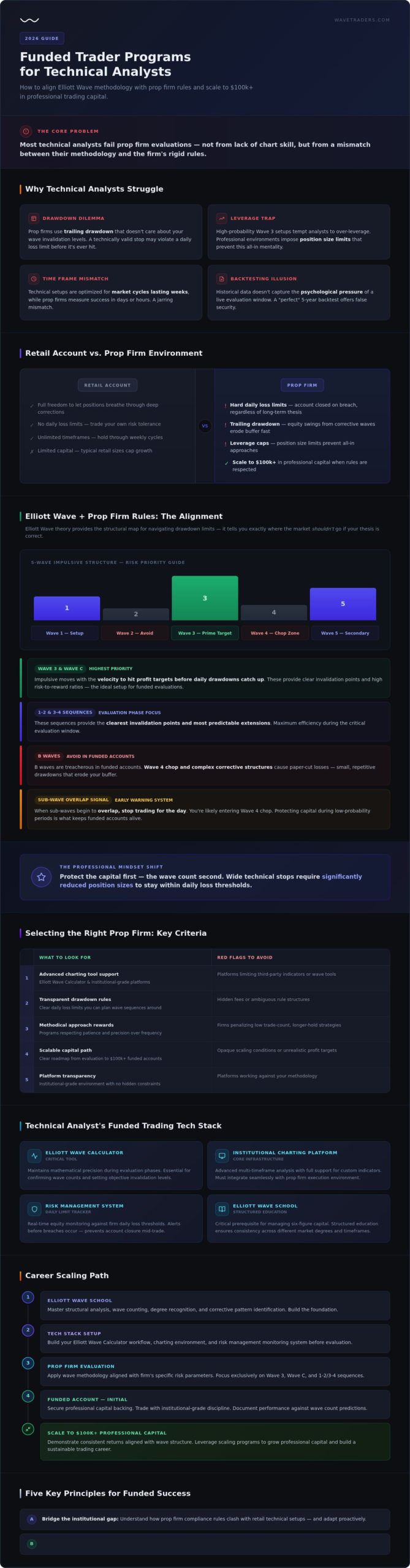
Why do most technical analysts fail prop firm evaluations despite having a clear edge on their charts? You’ve likely spent years mastering market structure and wave counts, only to find that a single volatility spike or a rigid drawdown rule can wipe out weeks of disciplined work. It’s frustrating when a platform’s limitations or hidden fees feel like they’re designed to work against your methodology rather than support it. You need a setup that rewards your patience and precision.
Finding the right funded trader program for technical analysts is about more than just high leverage; it’s about finding a partner that respects the logic of professional-grade analysis. In this guide, you’ll discover how to align your technical strategies with specific prop firm rules to secure and scale up to $100k or more in professional trading capital. We’ll examine the top programs for 2026, focusing on those that offer the advanced charting tools and risk parameters necessary for a methodical, wave-based approach. You’ll learn how to identify which platforms provide the institutional-grade environment required to turn your chart patterns into a sustainable professional career.
Many traders spend years refining their ability to read price action, yet they find the transition to a professional environment jarring. The primary reason isn’t a lack of chart-reading skill; it’s the sudden shift from the total freedom of a retail account to the strict compliance of a prop firm. In a retail account, you might allow a position to breathe through a deep correction. However, a funded trader program for technical analysts introduces hard boundaries, such as daily loss limits, that don’t care about your long-term wave count. If the market experiences a minor intraday spike that violates a daily limit, your account is closed, even if your technical analysis is eventually proven correct.
Traditional backtesting often creates a false sense of security. You might find a “perfect” strategy that works over five years of data, but that data doesn’t account for the psychological pressure of a live evaluation window. Most technical analysts struggle because their setups are optimized for market cycles that last weeks, while prop firms often measure success in days or hours. This mismatch forces a change in how you view the charts. You can’t rely solely on the pattern; you must also master the math of the firm’s specific constraints.
The most significant hurdle for technical analysts is often the trailing drawdown. Traditional technical analysis teaches us to place stops at logical invalidation points, like the start of an impulsive move. If that stop is 2% away and the prop firm has a tight daily limit, your technically sound trade might trigger a violation before it ever hits your stop. Complex corrective waves, such as flats or triangles, often involve choppy equity swings. While these are normal parts of market structure, they can erode your drawdown buffer quickly. You can’t simply “set and forget” a trade when the firm’s rules require active equity management.
Another common pitfall occurs when an analyst identifies a high-probability “Wave 3” setup. The temptation to maximize leverage is high because the technical edge looks undeniable. However, most professional environments impose leverage caps or position size limits that prevent this all-in mentality. Succeeding in a funded trader program for technical analysts requires balancing your technical invalidation levels with the firm’s specific risk metrics. If your technical setup requires a wide stop to remain valid, you must reduce your position size significantly to stay within the firm’s daily loss thresholds. It’s about protecting the capital first and the wave count second.
Elliott Wave theory isn’t just about predicting price; it’s a structural map for managing volatility. For anyone entering a funded trader program for technical analysts, this map is essential for navigating drawdown limits. It tells you exactly where the market shouldn’t go if your thesis remains correct. Elliott Wave theory provides the objective market logic required by prop firm evaluators by defining specific price levels where a technical thesis is mathematically invalidated. By identifying Wave 3 or Wave C structures, you can find entries with high risk-to-reward ratios. These impulsive moves provide the velocity needed to hit profit targets before daily drawdowns catch up to you.
Sub-wave counts act as a professional early warning system. If you’re counting a five-wave impulsive move and the sub-waves begin to overlap, it’s a clear signal to stop for the day. You’re likely entering a Wave 4 chop. This environment is where most traders lose their equity through small, repetitive losses, often called paper-cuts. Adjusting your trade frequency based on the current market degree ensures you stay on the sidelines during these complex corrections. When you understand the degree of the trend, you can stay patient until a clear Wave 5 or a new impulsive sequence begins. This disciplined approach protects your capital during the low-probability periods that often sink funded accounts.
During evaluation phases, focus on the 1-2 and 3-4 sequences for maximum efficiency. These sequences provide the clearest invalidation points and the most predictable extensions. Technical analysts should generally avoid trading B waves in funded accounts. These structures are often deceptive and prone to whipsaws, which can quickly trigger daily loss limits. Instead, align your Fibonacci extension targets with the profit goals of the prop firm. If the 1.618 extension of Wave 1 aligns with your target, you have a sound reason to stay in the trade. Success in a funded trader program for technical analysts often comes down to this level of mathematical precision. For those looking to refine this skill, the Elliott Wave School provides the foundational training needed to master these high-probability entries.
Selecting the right funded trader program for technical analysts requires looking past flashy marketing and focusing on technical infrastructure. In 2026, the professional analyst needs more than just a login; they need a platform that doesn’t hinder their methodology. Speed of execution and data transparency are non-negotiable. If you’re tracking sub-waves on a one-minute chart, even a minor delay or a widened spread during a news event can invalidate your entry. You should prioritize firms that offer institutional-grade feeds to ensure your price levels align with the broader market.
MetaTrader 5 and TradingView integration have become the industry standard for a reason. These platforms allow for advanced charting and the use of sophisticated analysis tools that basic proprietary web-traders simply can’t match. For swing-oriented analysts, the “No Time Limit” evaluation model is perhaps the most significant development in recent years. It removes the pressure to force trades during low-probability corrective cycles. This allows you to wait for the clear impulsive structures that define your edge, rather than gambling to meet an arbitrary deadline. Whether you choose direct funding or an evaluation model depends on your capital needs and your confidence in maintaining discipline under strict drawdown rules.
A technical analyst is only as good as their tools. Before signing up, you should verify if the program supports custom indicators and Elliott Wave scripts. Many proprietary platforms are too basic for professional needs and lack the flexibility required for multi-timeframe analysis. You should also look for brokers that offer raw spreads. High-probability technical setups rely on precision; excessive slippage can quickly turn a winning Wave 3 entry into a break-even trade. For a comparison of where to perform your analysis, see our guide on the Best Free Elliott Wave Charts in 2026 for tool ideas.
It’s easy to be lured by 90% profit splits, but these often come with extremely tight drawdown rules that leave little room for market noise. For most, a 70% split with looser rules is far more sustainable for long-term career growth. Strict “Consistency Rules” can also be a trap for technical swing traders. If your methodology relies on catching a single large Wave 3 or Wave C once a month, a rule that requires you to trade every day or maintain a specific volume can force you into low-quality setups. Our Funded Trader Program Guide provides a deeper breakdown of how to weigh these rules against your specific analytical style.
A professional tech stack acts as the bridge between technical theory and institutional compliance. For anyone enrolled in a funded trader program for technical analysts, your tools must do more than just draw lines; they need to manage risk in real-time. High-quality charting software like TradingView or MetaTrader 5 is the foundation, but the real advantage comes from specialized utilities. An Elliott Wave Calculator is indispensable for projecting precise price targets and invalidation levels before you even open a position. By pre-calculating these levels, you ensure that your technical stop loss never accidentally violates a prop firm’s daily drawdown threshold.
Risk management overlays are another critical component of a professional setup. These scripts can prevent “fat-finger” errors or over-leveraging during the fast-moving impulsive waves where emotions often run high. When you’re trading a Wave 3, the speed of the market can be overwhelming. Having a system that automatically scales your position based on the firm’s specific equity rules allows you to focus purely on the market structure. This automation reduces the cognitive load, letting you maintain the calm, measured mindset required for professional-grade execution.
The debate between automated and manual wave counting is ongoing, but for a funded account, manual counting remains the safer choice. Automated tools often miss the nuanced context of higher-degree cycles, leading to false signals that can put your capital at risk. Instead, use Fibonacci retracement tools to pre-calculate your drawdown buffers manually. This approach lets you see exactly how much “breathing room” a trade has relative to the firm’s strict limits. Validating your bias through real-time analysis services can also provide the necessary second opinion to keep your technical perspective objective and disciplined.
A technical analyst’s journal should be a database of pattern performance rather than just a list of wins and losses. You should tag every trade by “Wave Type” to identify whether you’re more successful in impulsive Wave 3s or corrective Wave C structures. This data reveals your personal technical edge and tells you which setups to avoid during an evaluation. Additionally, monitoring “Time in Trade” is vital for compliance with firms that prohibit weekend or overnight holding. Reviewing Is an Elliott Wave Subscription Worth It? can show you how professional analysis helps cut the learning curve by providing a clear framework for these journals. To truly professionalize your approach, consider using the tools available at Wavetraders to refine your execution and maintain consistency.
Managing six-figure capital is a significant responsibility that requires a profound shift in your professional mindset. It’s one thing to trade a small personal account where the stakes feel lower; however, successfully navigating a funded trader program for technical analysts requires institutional-level discipline. Active since 2003 in market education, Wavetraders has refined a curriculum that bridges the gap between theory and professional execution. Structured education isn’t just a recommendation; it’s a prerequisite for anyone who wants to move beyond retail habits. By mastering the deeper mechanics of market structure, you can enter any challenge with the quiet confidence of a practitioner who knows their edge.
Transitioning from the Elliott Wave School to a live funded environment is a methodical process. This is where community insights become a vital asset. When you’re in the middle of a funding phase, it’s easy to lose objectivity. Being part of a community of like-minded analysts allows you to cross-reference your counts and stay grounded. It’s about tracking the markets together, ensuring that your technical bias doesn’t lead to unnecessary errors during critical drawdown periods.
The core of our curriculum is teaching you to identify the specific, high-probability patterns that prop firms reward. These are the impulsive moves that provide the risk-to-reward ratios necessary for long-term survival. Our video lessons walk through real-time chart examples, showing you exactly how to apply wave theory to modern prop firm constraints. You’ll learn how to pass a funded trader challenge by focusing on the structures that offer the highest probability of success with the lowest relative risk.
Once you’ve mastered the theory, the next logical step is securing the capital your analysis deserves. We suggest a 90-day roadmap that moves from academy learning to active funding status. To support this transition, we offer an exclusive 30% discount for the funded trader program for technical analysts through our partnership with Eightcap. This ensures you have the execution speeds and transparency required for professional-grade wave analysis. Your technical journey doesn’t have to be a solitary pursuit. Join the Wavetraders community today and start building a career based on precision and discipline.
Transitioning from a retail hobbyist to a professional analyst requires more than just a sharp eye for patterns; it demands a synergy between market structure and institutional risk management. We’ve explored how a methodical approach allows you to navigate rigid drawdown limits without sacrificing your technical edge. By aligning high-probability wave counts with specific firm rules, you transform the evaluation process from a high-pressure gamble into a calculated professional milestone. The right funded trader program for technical analysts acts as a force multiplier for your expertise, providing the capital necessary to scale your career.
With over 20 years of experience in market education, Wavetraders offers the structural framework and comprehensive video lesson library needed to master this transition. Our graduates don’t just learn theory; they gain a practical roadmap to professional funding, including an exclusive 30% discount on partnered programs. To take the next step in your trading career, Apply for the Wavetraders Elliott Wave School and Secure Your Funded Future. The markets will always offer new cycles and complex patterns; your task is simply to be prepared with the right capital and discipline when the next impulsive move begins.
Elliott Wave theory is highly reliable for evaluations because it defines precise price levels where a technical thesis is proven wrong. This allows you to set hard stops that align with prop firm risk parameters. By focusing on impulsive Wave 3 or Wave C structures, you can achieve the high risk-to-reward ratios needed to hit profit targets without violating drawdown limits. It replaces guesswork with a structural map of market sentiment.
The ideal funded trader program for technical analysts is one that provides institutional-grade data feeds and supports advanced charting platforms like MetaTrader 5 or TradingView. Wavetraders recommends programs partnered with Eightcap due to their execution speed and transparency. These platforms allow you to use custom scripts and the Elliott Wave Calculator effectively. Choosing a firm with “No Time Limit” challenges is also beneficial for maintaining a patient, technical approach.
Most prop firms allow the use of indicators, but relying solely on automated wave counting is risky. These tools often miss the nuanced context of higher-degree cycles or complex corrections. In a funded environment, a manual count verified by your own analysis is much safer. You should use indicators as supportive tools rather than primary decision-makers to ensure your trades respect the firm’s strict daily loss limits.
You only need enough capital to cover the initial evaluation fee, which varies based on the account size you’re targeting. For example, a $100k account challenge typically costs a few hundred dollars. Wavetraders members can access an exclusive 30% discount on partnered programs, significantly lowering the entry cost. This allows you to trade professional-grade capital without risking your own life savings while you apply your technical expertise to the markets.
If you hit a daily loss limit, your account is typically breached and closed, regardless of how correct your technical setup might be in the long run. Prop firms prioritize capital preservation over your specific wave count. This is why it’s vital to size your positions based on the firm’s daily drawdown rules rather than just your chart’s invalidation point. Professional analysts always prioritize the firm’s hard risk boundaries over their trade thesis.
Many modern prop firms allow swing trading, but you must check their specific rules regarding weekend and overnight holding. For technical analysts using Elliott Wave cycles, “No Time Limit” evaluations are ideal. These programs let you wait for larger degree Wave 3 moves without the pressure of an expiring challenge. Always ensure your chosen funded trader program for technical analysts supports the timeframe your methodology requires for accurate pattern recognition.
It’s essential to master technical analysis before attempting an evaluation. Attempting a challenge without a proven methodology like the one taught at the Elliott Wave School often leads to avoidable losses. You need to understand market structure, Fibonacci extensions, and risk management before you’re responsible for six-figure capital. Learning the theory first ensures you have the discipline to follow a plan when the psychological pressure of a live account increases.
Most analysts fail because they don’t adjust their retail habits to fit institutional compliance rules. They might have a great wave count but ignore the firm’s daily loss limits or trailing drawdowns. Others struggle with the psychological pressure of the evaluation window, leading to over-trading during corrective Wave 4 chop. Success requires a bridge between your technical edge and the firm’s specific risk metrics, which is a skill developed through professional-grade education.
DISCLAIMER
Any reviews, news, analysis, prices or other information contained on our website is provided as general market commentary and delivered electronically through a distribution channel to larger number of clients, therefore does not constitute investment advice or investment research. We are not trading advisors. Most of our work is for educational purposes only, with information based on Elliott Wave theory in real time. Trading forex, futures, options, stocks, cryptocurrenices or any another trading market carries a high level of risk, and may not be suitable for all investors.
The possibility exists that you could lose some or all of your initial investment; therefore you should not invest money that you cannot afford to lose. Our website and the information that we provide should not be relied upon as a substitute for extensive independent research before making your investment decisions. In no event will we be liable for any loss or damage on your account in connection with, the use of our products. For any real cash investments you have to contact your financial advisor.
Any information or material contained on our website is owned by Val Global d.o.o.. Reproduction is prohibited without Val Global d.o.o. prior license in writing.
By continuing to use the site, you agree to the use of cookies. Learn more.
The cookie settings on this website are set to "allow cookies" to give you the best browsing experience possible. If you continue to use this website without changing your cookie settings or you click "Accept" below then you are consenting to this.