Why does every Elliott Wave count look perfect on a finished chart, yet seems to fall apart the moment you try to trade it in real time? Most traders feel this exact frustration. You might spend weeks memorizing thirteen different wave patterns only to find yourself constantly adjusting your labels after the market has already moved. It’s an exhausting cycle that makes the theory feel more like an academic exercise than a practical trading tool. Finding the right Elliott Wave forex course shouldn’t mean paying for more confusion; it should provide a clear, rule-based path to execution.
We understand that the gap between theory and a live FX setup can feel immense. This guide will show you how to bridge that gap by focusing on dynamic market structure rather than static patterns. You’ll learn what to look for in a curriculum to ensure it delivers real-world results, including how to identify high-probability entry and exit signals. We’ll also examine how a structured approach gives you the confidence to apply these techniques to pass a funded trader challenge. By the end, you’ll know exactly how to choose an education that turns complex counts into actionable trade plans.
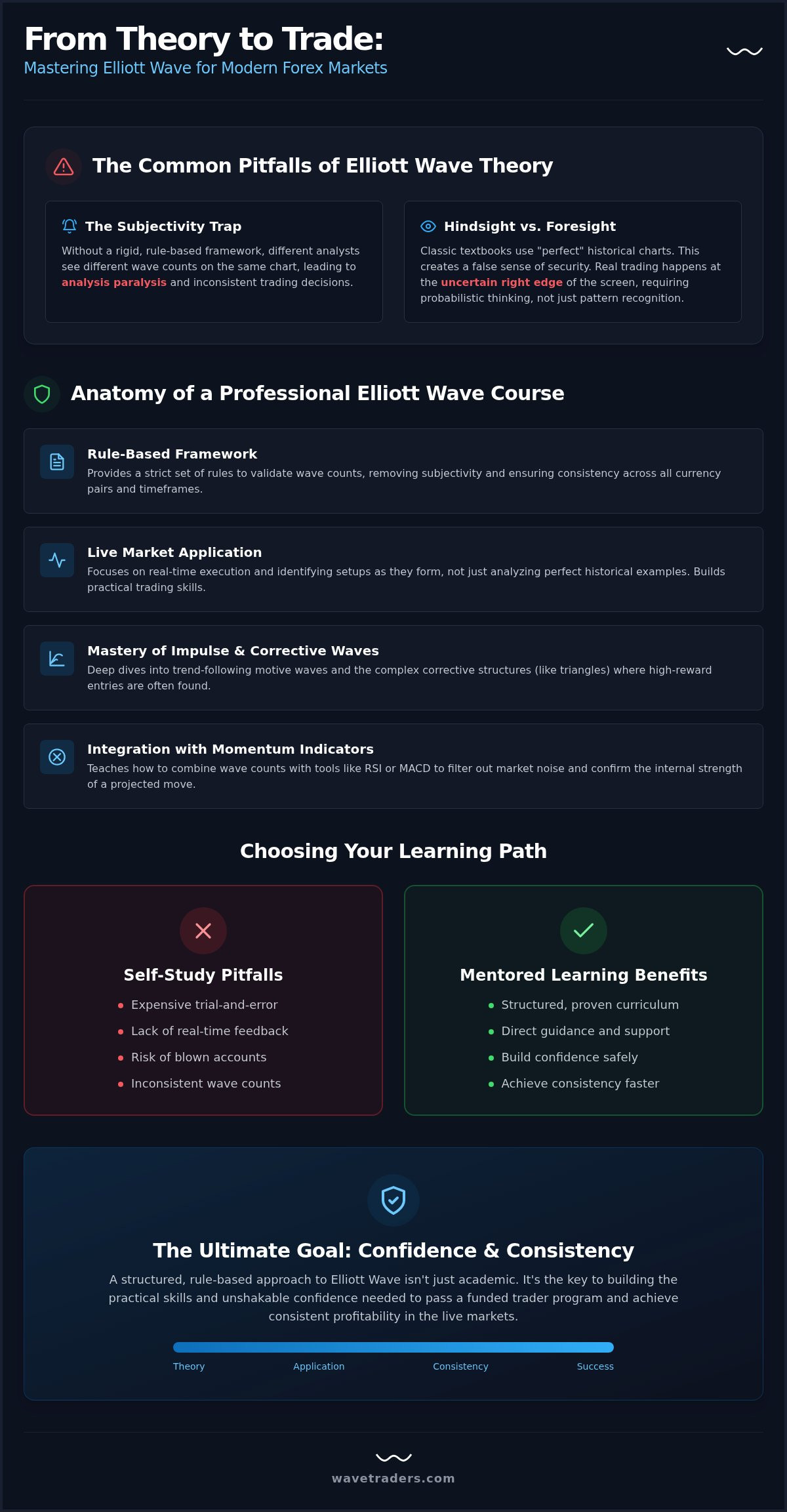
Many traders begin their journey with the Elliott wave principle by reading classic texts, but they soon find the application is harder than the theory suggests. The primary hurdle is the “Subjectivity Trap.” It’s quite common to see three different analysts looking at the same EUR/USD chart and arriving at three different wave counts. This happens because the theory allows for various interpretations of corrective structures. Without a rigid, rule-based framework, traders often find themselves in a state of analysis paralysis. They can’t pull the trigger because they’re worried about a missed sub-wave or an alternative count. Choosing a comprehensive Elliott Wave forex course can help you avoid these common pitfalls by providing clear rules for count validation.
Academic wave counting is beautiful on a printed page. It often fails to account for the raw volatility of the 2026 forex market, though. Standard textbooks show idealized moves that rarely occur in a landscape dominated by central bank shifts and rapid geopolitical events. An effective Elliott Wave forex course must bridge the gap between these academic ideals and the messy reality of live price action. You need to move beyond identifying patterns for the sake of it. Start looking for actionable trading signals that offer a clear risk-to-reward ratio instead. This shift in perspective is what separates a student from a professional practitioner.
Forex markets have changed. High-frequency trading and algorithmic liquidity now influence how price moves on a micro-level. This often results in noisy price action on lower timeframes. On these charts, the classic 1-2-3-4-5 impulse cycle can look distorted or truncated. To navigate this, you shouldn’t rely on wave counts in isolation. Combining wave theory with momentum indicators like the RSI or MACD helps filter out the noise. This synthesis allows you to see if the internal strength of a move actually matches the wave count you’ve projected. It turns a subjective observation into a data-driven conclusion.
It’s easy to look at a chart from six months ago and spot a perfect zigzag correction. Trading happens at the hard right edge of the screen where the future is uncertain, however. Many courses rely on cherry-picked historical examples, which gives students a false sense of security. Wavetraders focuses on real-time forecasting and live market interpretation rather than simply dissecting past patterns. Success in the FX market requires moving from what happened to assessing what is most likely to happen next. By focusing on probability and clear invalidation levels, you can manage the inherent uncertainty of market forecasting without the anxiety of being wrong about a specific count.
A high-quality Elliott Wave forex course goes beyond simply explaining basic patterns. It needs to provide a structured curriculum that moves from simple impulse waves to the most complex corrective structures. Many students get lost in the theory because they lack a logical progression. By grounding the education in research on Elliott Wave’s effectiveness, a professional course validates why these patterns repeat. You shouldn’t settle for static, cherry-picked historical charts that look perfect after the move has happened. Instead, look for a program that uses live market examples to show how to identify a setup while price is still moving. This real-time application is the only way to build the muscle memory required for the fast-paced currency markets.
Understanding motive waves is critical for trend following. These waves provide the momentum needed to drive price toward your target. However, forex markets spend a significant amount of time in sideways ranges. Learning to navigate the Elliott Wave triangle pattern allows you to stay patient during these consolidations. Identifying the end of a correction is where the highest reward-to-risk entries are found. This skill is essential for anyone taking a wave theory trading course to improve their market timing.
Fibonacci levels act as the DNA of wave measurement. You can’t have a reliable wave count without confirming the mathematical relationships between waves. Retracements and extensions help you verify the degree of a wave and its likelihood of completion. To simplify this process, a professional course often provides an Elliott Wave calculator to automate these calculations. By using these levels, you can set logical stop-losses based on wave invalidation points, ensuring your risk is always managed.
Mentorship and community access are the final pieces of the puzzle. Trading is often a solitary pursuit, but your learning process shouldn’t be. Having access to experienced practitioners who can verify your counts is invaluable for building confidence. It helps you see where your bias might be clouding your judgment. If you are evaluating an Elliott Wave forex course, prioritize those that offer direct feedback on your analysis. This ensures you aren’t just memorizing rules but learning how to apply them. If you’re ready to move beyond basic theory, you can explore our professional FX services to see how these concepts apply to live markets every day.
Deciding between self-study and a structured Elliott Wave forex course often comes down to how much you value your time and capital. While the internet is full of free tutorials, this path carries significant hidden costs. You may spend months sifting through contradictory advice, only to pay ‘market tuition’ in the form of blown accounts and missed opportunities. A formal wave theory trading course provides the necessary guardrails. It keeps you focused on the rules that actually matter in a live environment. By observing a professional analyst’s daily workflow, you learn how to make real-time adjustments as price action evolves, a skill that static PDF guides cannot replicate.
Reaching a level of unconscious competence in wave counting doesn’t happen overnight. It typically requires several months of consistent practice to move beyond basic pattern recognition. Many traders quit before the six-month mark because they lack a clear roadmap to application. Structured video lessons are essential here. They walk you through live chart setups, explaining the reasoning behind a specific count rather than just showing a finished result. This methodical approach accelerates your development. It’s particularly beneficial for those preparing for a funded trader program where disciplined execution is mandatory.
Learning in isolation is one of the biggest hurdles for technical analysts. Without a feedback loop, it’s easy to develop a bias that leads to over-leveraging on a ‘perfect’ count that isn’t actually there. Having your counts critiqued by a mentor or a community of peers is the fastest way to sharpen your skills. Enrolling in a dedicated Elliott Wave school that emphasizes peer review and mentor feedback transforms this isolated pursuit into a collaborative learning experience. This collaborative environment offers several advantages:
Building this confidence through a specialized FX service ensures that you aren’t just guessing. You’re following a proven methodology alongside practitioners who have navigated similar market conditions for years. This structured learning environment turns a complex theory into a practical, repeatable process for identifying high-probability trade setups.
Choosing the right mentor is a critical step in your development as a technical analyst. You want to ensure the curriculum is grounded in reality rather than just theory. Start by checking the instructor’s track record for transparency. Do they provide real-time analysis, or do they only show historical “proof” once the move is over? A legitimate Elliott Wave forex course should offer regular updates on major pairs like EUR/USD or GBP/JPY while the market is active. This “live factor” is crucial because it demonstrates how a professional handles evolving price action. You should also look for tool integration, such as an Elliott Wave Calculator, to help simplify the complex Fibonacci math involved in wave validation. Finally, verify the support system. You need a place to ask questions when a sudden market move doesn’t fit your primary count.
A comprehensive program must cover the full spectrum of wave degrees. This includes everything from the multi-year Grand Supercycle down to the intra-day Subminuette. Understanding these degrees helps you maintain your perspective on the higher timeframe trend while trading lower timeframe setups. The curriculum should also focus on the psychology behind the waves. Each structure represents a specific shift in market sentiment, and understanding the “why” behind the move makes the “what” much easier to spot. Ensure the course includes advanced patterns like expanded flats and double zig-zags, as these complex corrections are frequent in the currency markets. The same analytical discipline applies across asset classes; for example, a thorough Cardano Elliott Wave analysis uses these same degree frameworks to map multi-year crypto cycles and identify high-probability turning points.
It’s vital to avoid “get rich quick” schemes that use Elliott Wave as a marketing hook. The theory is a powerful tool for mapping market structure, but it provides probabilities rather than certainties. A professional educator will be honest about the fact that counts can and do change as new price data arrives. They’ll teach you to look for invalidation levels that tell you when your count is wrong. A disciplined approach to Elliott Wave risk management remains the only way to survive the inherent uncertainty of the forex market, turning those invalidation levels into precise stop-loss points that protect your capital. If you’re ready to learn a methodical, rule-based approach to the markets, you can enroll in our Elliott Wave School to begin your journey with confidence.
The Wavetraders Elliott Wave School is built on the principle that technical analysis is a skill best learned through active participation. Our curriculum moves methodically from the foundational rules of impulse waves to the advanced execution strategies required in modern markets. We’ve been providing active market education since 2003, and our approach focuses on turning complex theory into a practical, repeatable process. Our FX Service acts as a daily guide, providing real-time wave counts that allow you to see how a professional analyst interprets shifting price action. This isn’t a static environment. It’s a living classroom where the goal is to develop the quiet confidence needed to trade independently without the pressure of hype or sensationalism.
Theoretical knowledge alone isn’t enough to survive the volatility of the currency markets. Our video lessons are specifically designed to bridge the gap between classroom concepts and live chart execution. We focus heavily on the internal structure of price moves, helping you anticipate potential reversals before they occur. By utilizing our Elliott Wave Calculator, you can refine your entry and exit signals with mathematical precision. This tool simplifies the complex Fibonacci relationships that define high-probability setups, allowing you to focus on the trade rather than the math. Whether you’re tracking major FX pairs, digital currencies, or commodities, our platform provides a unified view of market structure across multiple asset classes.
Passing a prop firm evaluation requires more than just a high win rate. It demands a disciplined, rule-based approach to risk management and market structure. A structured Elliott Wave school provides the necessary framework to maintain this discipline under pressure. It gives you clear invalidation levels that protect your capital during corrective phases, which is essential for meeting the strict drawdown requirements of most evaluations. Understanding how to apply Elliott Wave risk management techniques — including precise position sizing and trade invalidation rules — is what separates traders who pass funded challenges from those who repeatedly fail them. We’ve established partnerships with leading prop firms to help our students transition into professional trading roles more effectively.
Members of our school can leverage a 30% discount on funded trader program evaluations, making the path to professional capital more accessible. This synergy between education and funding ensures that you aren’t just learning in a vacuum; you’re building a career. If you’re ready to move beyond hindsight analysis and start tracking the markets with a seasoned practitioner, apply here to join the Elliott Wave School and start your professional journey today. We’ll work through the counts together, one wave at a time.
Mastering the FX market requires a shift from academic memorization to practical, rule-based execution. We’ve explored how a professional Elliott Wave forex course provides the necessary guardrails to avoid the subjectivity trap and navigate modern market volatility. Success isn’t just about spotting historical patterns; it’s about identifying high-probability setups at the hard right edge of the chart while managing risk with precision. Since 2003, we’ve focused on providing the expert analysis and real-time counts across FX and crypto that help traders build genuine confidence. By integrating these technical skills with disciplined execution, you can bridge the gap between education and passing professional evaluations. Members also gain access to exclusive benefits, including a 30% discount on funded trader programs to support their career progression. It’s time to stop second-guessing your counts and start following a methodical path toward market mastery.
Start your journey to market mastery; apply to the Elliott Wave School today
We look forward to tracking the markets together and helping you achieve a professional level of competence in your trading journey.
Elliott Wave theory remains highly effective in 2026 because it tracks the repetitive nature of mass human psychology. While high-frequency algorithms now influence market microstructure, the broader trends and corrective cycles in the forex market still follow recognizable patterns. Success requires adapting the theory to modern volatility by using rules that account for fast-paced price action. This makes a structured Elliott Wave forex course essential for traders who want to distinguish between noise and genuine market sentiment.
Most beginners can grasp the basic rules and patterns within three months of consistent study. However, reaching a level of unconscious competence where you can count waves in real time typically takes six months to a year. This timeline depends heavily on whether you follow a structured path or try to learn through disjointed tutorials. Regular practice on live charts is the only way to shorten this learning curve and build technical confidence.
You can definitely apply wave analysis to day trading because the patterns are fractal. This means the same structures appearing on weekly charts also manifest on 5-minute or 15-minute timeframes. Day traders use the theory to identify the direction of the immediate trend and find low-risk entry points at the end of minor corrections. It’s a powerful way to filter out market noise during busy sessions like the London or New York opens.
The best option for busy professionals is an on-demand video curriculum that allows for self-paced learning. You need a program that provides clear, modular lessons you can watch during your off-hours. Access to daily market updates and a recorded webinar archive is also vital. This structure ensures you stay aligned with current market cycles even if you don’t have the time to monitor the charts during the standard trading day.
You don’t need proprietary software to count waves; most modern charting tools work perfectly for manual analysis. However, using a specialized Elliott Wave Calculator can significantly improve your accuracy. These tools automate the Fibonacci math required to validate wave extensions and retracements. While the analysis remains a manual skill, the calculator ensures your projections are mathematically sound and consistent with core rules, reducing the chance of human error.
Elliott Wave provides a structural map of the market that methods like Smart Money Concepts (SMC) or pure Price Action often lack. While SMC focuses on liquidity and Price Action looks at candle patterns, wave theory explains where those events fit within the broader cycle. Many successful traders combine these approaches. They use wave counts to determine the overall direction and Price Action to refine their specific entry and exit signals.
Investing in a specialized Elliott Wave forex course is often the difference between passing and failing a funded trader challenge. Prop firms require strict adherence to drawdown limits and disciplined execution. Wave theory teaches you exactly where a trade idea is invalidated, allowing you to set precise stop-losses. This structured approach to risk management is essential for meeting the professional standards required to manage a funded account and protect your capital.
The most frequent mistake is forcing a count to fit a personal bias or a desired trade direction. Beginners also tend to ignore the three core rules, such as letting wave four overlap the peak of wave one in a motive move. Another common error is over-complicating the analysis by looking for complex corrections before confirming simple ones. Staying disciplined and following a strict validation checklist is the best way to avoid these early pitfalls.
DISCLAIMER
Any reviews, news, analysis, prices or other information contained on our website is provided as general market commentary and delivered electronically through a distribution channel to larger number of clients, therefore does not constitute investment advice or investment research. We are not trading advisors. Most of our work is for educational purposes only, with information based on Elliott Wave theory in real time. Trading forex, futures, options, stocks, cryptocurrenices or any another trading market carries a high level of risk, and may not be suitable for all investors.
The possibility exists that you could lose some or all of your initial investment; therefore you should not invest money that you cannot afford to lose. Our website and the information that we provide should not be relied upon as a substitute for extensive independent research before making your investment decisions. In no event will we be liable for any loss or damage on your account in connection with, the use of our products. For any real cash investments you have to contact your financial advisor.
Any information or material contained on our website is owned by Val Global d.o.o.. Reproduction is prohibited without Val Global d.o.o. prior license in writing.
By continuing to use the site, you agree to the use of cookies. Learn more.
The cookie settings on this website are set to "allow cookies" to give you the best browsing experience possible. If you continue to use this website without changing your cookie settings or you click "Accept" below then you are consenting to this.