Why is it that three different analysts can look at the same price chart and arrive at three completely different labels? If you’ve ever felt the frustration of a “perfect” impulse wave suddenly transforming into a complex correction the moment you enter a trade, you’re not alone. Many traders start a wave theory trading course with high hopes, only to find themselves paralyzed by subjectivity when the markets are moving in real time. It’s a common hurdle that separates those who study patterns from those who actually trade them with confidence.
Finding a learning path in 2026 requires looking for education that translates academic theory into repeatable, real-time profit. In this guide, we’ll explore how to evaluate modern Elliott Wave education to ensure it provides a clear framework for market cycles. We’ll also look at how to integrate Fibonacci levels for precision and how to finally gain confidence in your primary wave count without the second-guessing that often haunts the retail trading community.
A wave theory trading course is a structured curriculum designed to teach the R.N. Elliott Wave Principle, a method of market forecasting that identifies repetitive price patterns. Instead of viewing the market as a chaotic series of random events, this methodology treats price action as a reflection of collective human psychology. It’s the study of fractals; patterns that repeat at every scale of time, from a one-minute chart to a monthly trend. Students learn that markets move in specific cycles, alternating between impulsive waves that drive the trend and corrective waves that offer temporary pauses.
Many traders start by “drawing lines” on a chart, but without a deep understanding of the underlying psychology, those lines often lead to confusion. Self-teaching through scattered blog posts often results in “analysis paralysis,” where a trader sees three or four possible wave counts and has no logical way to determine which one is the primary path. Investing in a wave theory trading course is about shortening the 10,000-hour mastery curve by providing a cohesive framework. It moves the analyst from guessing to a state of quiet confidence based on objective rules.
While YouTube is full of tutorials, free education often lacks a logical chain from one lesson to the next. You might learn about a “zigzag” correction in one video and an “impulse” in another, but you won’t see how they integrate into a live market environment. Many “influencer” traders also oversimplify the theory to gain views, often ignoring the critical distinction between hard rules and flexible guidelines. In a professional setting, breaking a rule invalidates a count immediately. Guidelines, however, suggest what is likely to happen. Without a mentor to explain the difference, beginners often get stuck in “forever-correcting” counts that never actually lead to a trade.
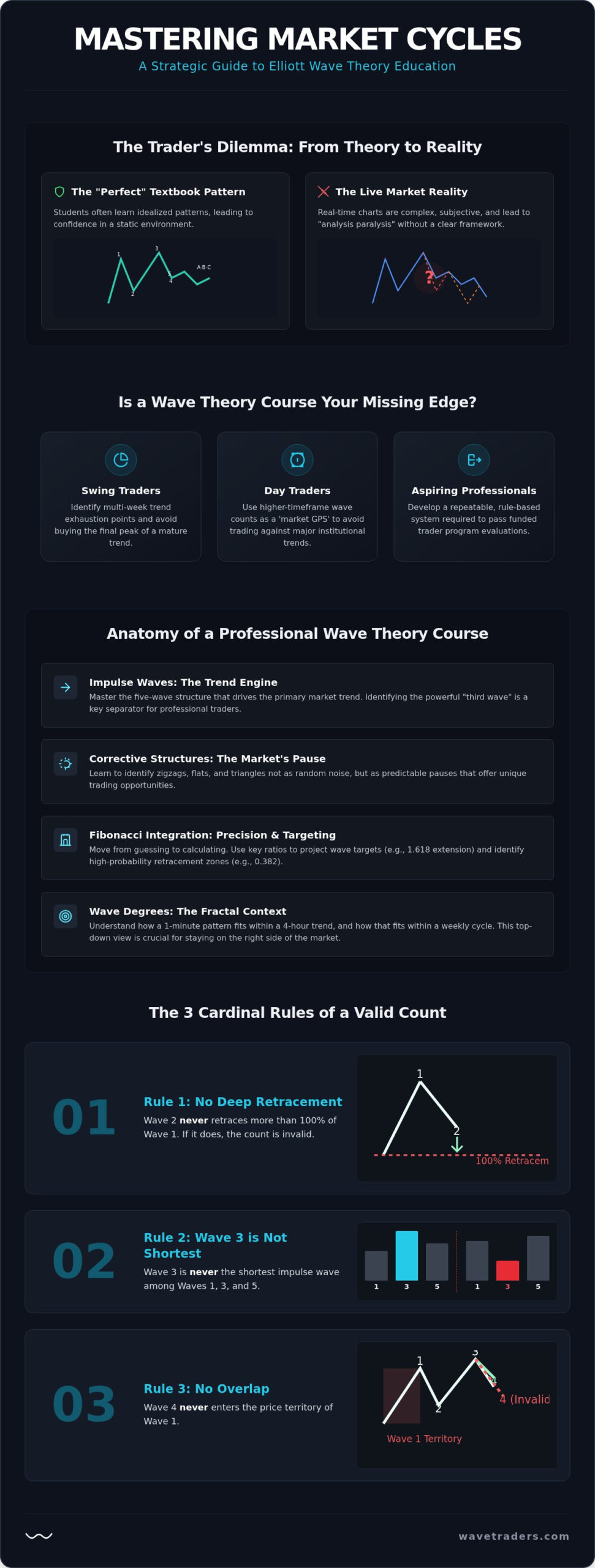
A high-quality wave theory trading course shouldn’t just show you what a pattern looks like in a textbook. It needs to demonstrate how to identify these structures while the candles are still forming in real time. The foundation of any curriculum begins with the five-wave impulse. This is the engine of the market trend. It’s where the most aggressive price movement happens, and identifying the “third wave” is often the difference between a struggling account and a professional one. Without a clear understanding of impulse waves, a trader is simply guessing at the direction of the next big move.
Mastering corrective structures is equally critical. While impulse waves are the engine, corrections like flats, zigzags, and triangles are the pauses that often confuse retail participants. A professional course will teach you to view these not as random noise, but as necessary breathers in a larger cycle. This is where Fibonacci integration becomes vital. By using specific ratios, you can predict wave 3 targets, often at the 1.618 extension, or find wave 4 retracement levels, frequently near the 0.382 mark. Understanding wave degrees then allows you to see how a small five-wave move on a 1-minute chart fits into a larger monthly cycle, giving you a “top-down” perspective that keeps you on the right side of the market.
In Elliott Wave theory, rules are the guardrails that prevent subjective bias. While many guidelines exist, these three rules are absolute. If any of them are violated, your wave count is incorrect and must be discarded immediately:
Once you’ve mastered the basics, a course should move into terminal moves like leading and ending diagonals. These patterns signal that a trend is nearing exhaustion and a significant reversal is likely. Perhaps the most important advanced concept to master is the Expanded Flat Elliott Wave: What It Is and How to Trade It. This specific corrective structure is a common trap for retail traders because it creates a “fake” breakout in both directions before the real trend resumes. Sideways consolidation phases are equally deceptive; understanding the Elliott Wave triangle pattern is essential for recognizing when a tightening range is actually a high-compression coil preparing for a powerful directional breakout. Learning to spot these patterns allows you to trade with a level of precision that most indicator-based systems simply cannot offer. If you’re ready to see these patterns applied in the current market, exploring the practitioner-led lessons at the Elliott Wave School can help bridge the gap between theory and execution.
Choosing a wave theory trading course often feels like a trade-off between cost and depth. In 2026, the market is saturated with different educational models, each promising mastery of the Wave Principle. However, the signal-to-noise ratio, which is the amount of actionable information versus filler, differs significantly depending on the format you choose. It’s important to understand how you learn best before committing your time and capital to a specific path.
The first model is the static video archive, common on platforms like Udemy. These are excellent for self-starters on a budget who need to learn the basic vocabulary of the wave principle without a large upfront investment. The second model is the academic certification, typically found on sites like Coursera. This is best for those seeking a resume boost or a formal credential, though it often lacks the visceral feel of live market volatility. The third model is the practitioner-mentorship, which we prioritize at Wavetraders. This approach is designed for those who want to trade alongside experts and see how theory adapts to shifting market conditions in real time.
There is a profound difference between looking at a “perfect” historical chart in a textbook and counting a live 5-minute candle in the middle of a news event. Static videos show you what worked in the past. Live analysis, however, shows you the actual decision-making process. It’s incredibly valuable to see an instructor admit when a count is invalidated; it teaches you how to pivot without emotional attachment. Daily video updates reinforce the core lessons of a wave theory trading course by applying them to current price action. This turns abstract theory into a lived experience that builds true competence.
It’s tempting to opt for the lowest entry price, but a cheap course can quickly become the most expensive investment you ever make if it leads to lost capital through poor execution. A professional course should be viewed through the lens of long-term value rather than just the initial sticker price. Look for programs that offer more than just lectures. Does the course provide practical tools, such as an Elliott Wave Calculator, to help with your projections? Subscription-based learning often provides more value than “lifetime access” to a static library because it includes the ongoing live-market “lab” where your skills are actually forged and tested.
The most dangerous trap in technical analysis is the search for academic perfection. Many traders spend years looking for a wave theory trading course that promises a “holy grail” count, only to find that their education doesn’t hold up when the market opens on Monday morning. This is often because the instructor is a historian rather than a practitioner. When you are vetting an educator, the first thing you should look for is transparency. If an instructor never shows a losing trade or an invalidated count, they aren’t showing you the reality of the markets. Real trading involves constant adjustment and the humble acknowledgement that the primary count can change.
Verify that the instructor’s focus aligns with the markets you actually trade. Elliott Wave theory is a universal language, but the personality of a move in the Forex market differs from the volatility found in Digital Currencies or Indices; for instance, Vici Trading Solutions offers valuable perspectives on how the ES and NQ differ in their market behavior. A quality course should focus on current, unfolding setups rather than cherry-picked historical data. This prevents “Hindsight Bias,” where patterns look obvious only after the move has completed. Instead, look for a curriculum that treats the market as a live laboratory where theories are tested daily.
An instructor should be an active market participant. You don’t want a lecturer who retired ten years ago; you want someone navigating the same 2026 volatility that you are. This is why daily analysis updates are so critical. They prove the methodology works in the current cycle. For example, seeing a professional’s EUR/USD Elliott Wave Analysis as the price action unfolds provides a level of education that a static textbook simply cannot match. It bridges the gap between knowing the rules and knowing when to execute.
Counting waves is only about 30% of the battle. The other 70% is execution, risk management, and psychology. A high-quality wave theory trading course must teach you exactly where your “Invalidation Level” sits. This is your stop loss. By using wave troughs and peaks, you can define clear risk-to-reward ratios before you ever place a trade. If a course focuses purely on counting without explaining how to manage a position when the count is wrong, it isn’t a trading course; it’s a math class. You need a framework that protects your capital while you wait for the high-probability setups to reveal themselves. If you’re ready to learn from practitioners who trade what they teach, you can explore the curriculum at our Elliott Wave School.
At Wavetraders, we believe a wave theory trading course shouldn’t end when the final video stops playing. Most educational platforms provide a static library of content and leave the student to navigate the markets alone. Our Elliott Wave School operates as a practitioner-led environment where the lessons serve as the foundation for daily live-market application. This “lab” approach ensures that you aren’t just memorizing patterns; you’re learning to identify them while they are still forming. It’s the difference between studying a map and actually driving the route.
We offer tiered membership paths tailored to specific market interests. FX traders and Digital Currency enthusiasts face different volatility profiles and liquidity cycles. By providing specialized paths, we ensure the analysis remains relevant to the instruments you actually trade. This community-driven model allows us to track the markets together, which significantly reduces the subjective bias that often leads to incorrect wave counts. When multiple practitioners see the same structure forming, it builds the confidence necessary to pull the trigger on a trade.
Many of our students aim for a career in professional trading. Our curriculum is specifically designed to prepare you for the Funded Trader Program. Prop firms have strict drawdown rules that require a disciplined approach to risk. Elliott Wave theory provides a natural advantage here because it defines clear invalidation levels. By knowing exactly where a count is wrong, you can maintain the tight risk management necessary to pass a professional evaluation. A structured wave theory trading course is often the best investment for a funded career because it provides the “rules of the road” that keep your account balance intact during periods of high volatility. Traders who also understand how to navigate consolidation phases using the Elliott Wave triangle pattern and its predictable post-triangle thrust gain a significant edge when managing positions through the sideways markets that frequently appear during funded trader evaluations.
Mastery requires more than just theory; it requires the right tools for the job. Students gain access to our Elliott Wave Calculator, which allows for precise Fibonacci projections without the manual guesswork. This is paired with daily video lessons that dissect current price action in major markets like the S&P 500, Gold, and Bitcoin. These updates show you how the core principles apply to the news and volatility of the current day. It’s this transition from theory to practice that turns a student into a consistent trader. Apply for the Elliott Wave School and start your practitioner journey today.
Success in the 2026 markets requires more than just memorizing a five-wave impulse or a complex correction. It demands a shift from passive observation to active participation. By choosing a wave theory trading course that prioritizes live-market application, you bridge the gap between academic knowledge and real-time execution. Remember that counting waves is only one part of the journey; true mastery comes from managing risk, identifying clear invalidation levels, and trading within a community that shares your methodology.
At Wavetraders, we’ve provided practitioner-led instruction since 2003. Our members gain access to real-time analysis across FX, Digital Currencies, and Commodities, ensuring they never have to navigate the charts alone. We also offer a 30% discount on Funded Trader Programs to help our students transition into professional careers. If you’re ready to stop guessing and start tracking the markets with precision, it’s time to take the next step.
Master the Wave: Join the Wavetraders Elliott Wave School and begin your journey toward a repeatable, rule-based trading framework today.
Elliott Wave theory remains a cornerstone of technical analysis in 2026 because it tracks the unchanging nature of human psychology. While market technology evolves, the collective emotions of fear and greed that drive price action continue to create the same fractal patterns. This methodology provides a reliable map for identifying where a trend is in its life cycle, regardless of the asset class.
Most traders find that a structured wave theory trading course requires roughly 20 to 40 hours of study to grasp the foundational rules and guidelines. However, achieving true proficiency is an ongoing process. Transitioning from theoretical knowledge to real-time application usually takes several months of practice in a live market environment to build the necessary pattern recognition skills.
The methodology is inherently fractal, meaning the same five-wave patterns seen on a weekly chart are visible on a 5-minute chart. Day traders use wave theory to find high-probability entry points within a larger trend. Knowing the higher-timeframe wave count helps intraday traders avoid the common mistake of trading against a major institutional move.
You don’t need to be a mathematician to use these tools effectively. Modern trading platforms and specialized calculators handle the heavy lifting of calculating price extensions and retracement levels. Your primary job as a trader is to identify the correct pattern; the software will then provide the precise Fibonacci ratios needed for your targets and stop losses.
High-liquidity markets are the best starting point because they most clearly reflect mass psychology without the distortion of low-volume spikes. Beginners often find success starting with major Forex pairs like EUR/USD or broad indices like the S&P 500. These markets provide the “cleanest” wave structures, making it easier to identify impulse and corrective moves as they develop.
The price of a wave theory trading course often reflects the level of ongoing support and live-market application included in the program. Static video archives are generally more affordable, while practitioner-led schools involving daily analysis and mentorship represent a higher investment. It’s important to weigh the cost against the potential for lost capital that comes from improper self-teaching.
Motive is a broad category that describes any wave moving in the direction of the larger trend. An impulse wave is a specific type of motive wave that must follow strict rules, such as having five distinct sub-waves and ensuring wave 3 is never the shortest. All impulse waves are motive waves, but not all motive waves are impulses.
While some software can assist in identifying potential patterns, full automation remains difficult in the current market. The subjective nature of wave counting often requires a human analyst to weigh different possibilities and consider the broader fundamental context. Most professional traders use automation for scanning and alerts but rely on their own judgment for final execution and risk management.
DISCLAIMER
Any reviews, news, analysis, prices or other information contained on our website is provided as general market commentary and delivered electronically through a distribution channel to larger number of clients, therefore does not constitute investment advice or investment research. We are not trading advisors. Most of our work is for educational purposes only, with information based on Elliott Wave theory in real time. Trading forex, futures, options, stocks, cryptocurrenices or any another trading market carries a high level of risk, and may not be suitable for all investors.
The possibility exists that you could lose some or all of your initial investment; therefore you should not invest money that you cannot afford to lose. Our website and the information that we provide should not be relied upon as a substitute for extensive independent research before making your investment decisions. In no event will we be liable for any loss or damage on your account in connection with, the use of our products. For any real cash investments you have to contact your financial advisor.
Any information or material contained on our website is owned by Val Global d.o.o.. Reproduction is prohibited without Val Global d.o.o. prior license in writing.
By continuing to use the site, you agree to the use of cookies. Learn more.
The cookie settings on this website are set to "allow cookies" to give you the best browsing experience possible. If you continue to use this website without changing your cookie settings or you click "Accept" below then you are consenting to this.