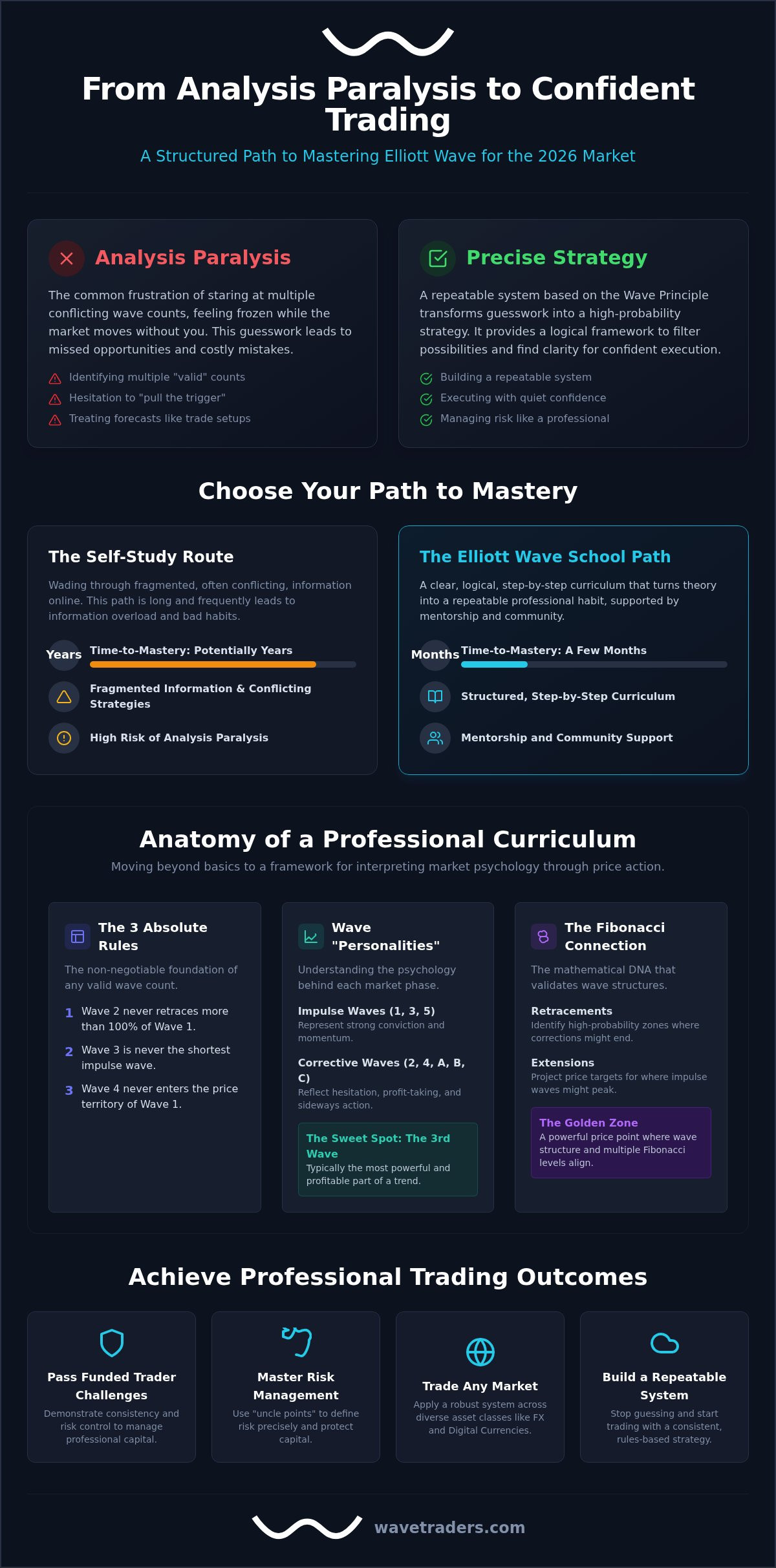
Why do so many traders spend years mastering complex labels only to freeze when it’s time to actually pull the trigger? It’s a common frustration. You’ve likely felt the sting of analysis paralysis, staring at three conflicting counts while the market moves without you. This is why finding a structured Elliott Wave school is about more than just learning rules; it’s about learning to trade. Corrective patterns often feel like a maze, and identifying a wave is one thing, but knowing exactly where your entry and exit belong is quite another.
We understand that the theory can feel overwhelming when the charts are live and your capital is at risk. This article will show you how to transform market guesswork into a precise, high-probability strategy. We’ll explore how to build a repeatable system based on the Wave Principle, designed to help you trade with quiet confidence. We will walk through the path to mastering real-time wave counting for the 2026 market landscape, providing you with the tools to pass a funded trader challenge and manage risk like a seasoned professional.
An Elliott Wave school is a structured educational environment that moves beyond basic definitions into practical market application. Most traders begin by memorizing patterns from a textbook, but they quickly encounter the “analysis paralysis” trap. This occurs when you identify three or four valid wave counts on a single chart, each suggesting a different direction. Without a logical framework to prioritize these counts, real-time trading becomes an exercise in frustration. A dedicated school provides the rules of engagement needed to filter these possibilities and find clarity.
The role of mentorship is particularly vital when distinguishing between a “forecast” and a “trade setup.” A forecast is simply an opinion on where the market might go. A trade setup is a specific set of conditions that offers a high-probability entry with a clearly defined stop-loss. In the volatile markets of 2026, the Elliott Wave Principle serves as a critical risk management tool. It allows you to identify “uncle points” where a count is invalidated, protecting your capital from unexpected swings in FX or digital currency markets. This precision is what separates the professional from the amateur.
Knowing the basic 1-2-3-4-5 impulse is rarely enough to sustain a professional career. The real challenge lies in the corrective phases. Mastering zigzags, flats, and complex triangles allows you to identify when a trend is merely resting rather than reversing. A professional Elliott Wave school teaches you to stop being a forecaster who tries to predict every market wiggle. Instead, you learn to think like a risk manager. You use wave theory to find the “sweet spot” of a move, typically the third wave or the C wave, where momentum is strongest and the risk-to-reward ratio is most favorable.
The internet is full of fragmented information that often leads to conflicting strategies. A structured curriculum prevents the information overload that stops most beginners in their tracks. By following a logical, step-by-step path, you learn to build a count from the higher timeframes down to the execution charts. Learning from practitioners who trade their own counts provides a level of insight you won’t find in a standard tutorial. This environment fosters the discipline needed to wait for high-probability setups. It’s much easier to maintain professional standards when you’re part of a community of like-minded traders rather than working in isolation. A dedicated Elliott Wave school turns theory into a repeatable, professional habit. For those who want to apply this same level of strategic thinking to other digital ventures, you might discover more about Direct-to-Consumer E-commerce Sales to see how niche brands are successfully navigating the modern marketplace.
A high-quality Elliott Wave school doesn’t just teach you to draw lines on a chart. It provides a logical framework for interpreting market psychology through price action. The foundation of any professional curriculum rests on the Three Rules: wave two never retraces more than 100% of wave one; wave three is never the shortest motive wave; and wave four never enters the price territory of wave one. While these rules are absolute, the guidelines, such as the rule of alternation, provide the necessary nuance for real-time analysis. Learning to distinguish between a hard rule and a flexible guideline is the first step toward consistent counting.
Understanding the “personality” of each wave helps confirm your count before the move is over. Impulse waves represent strong conviction, while corrective waves reflect hesitation and profit-taking. A deep dive into Elliott Wave triangle patterns is essential for navigating sideways markets where most traders lose capital. These patterns typically precede the final move in a sequence, offering a clear signal of what comes next. The Third Wave is the most powerful momentum move in a trend. By recognizing the signature of a third wave, you can shift from defensive tracking to aggressive execution with greater certainty.
Fibonacci ratios are the DNA of every professional wave count. They provide the mathematical validation for the structures we see on the charts. We use Fibonacci retracements to find where a correction might end and extensions to project where an impulse might peak. Finding the “Golden Zone” occurs when wave structure and multiple Fibonacci levels align at a single price point. You can simplify this process by using an Elliott Wave calculator to validate your trade ideas quickly. This integration of geometry and math transforms the theory from an academic exercise into a practical trading system.
Execution involves learning specific entry and exit signals based on wave completion points. It isn’t enough to know where the market is going; you must know exactly where your stop-loss belongs. Professional training emphasizes the critical role of historical chart analysis and live market tracking. This practice builds the pattern recognition muscle that allows you to act without hesitation. If you’re ready to move beyond basic theory, exploring a structured Elliott Wave school can provide the necessary bridge to professional execution. This methodical approach ensures that your trading remains objective, even when the markets become volatile. You might find it helpful to view our real-time analysis to see these principles in action.
Many beginners believe they can piece together a professional strategy through random YouTube videos or forum posts. This free content trap often leads to conflicting strategies because different creators use different variations of the theory without a unifying framework. A structured Elliott Wave school differs from a static course by providing a cohesive, living environment where the methodology remains consistent across all timeframes. While self-study typically takes between two and three years to achieve basic competency, a dedicated school environment can reduce that time-to-mastery to roughly six months by focusing on high-probability patterns and removing the guesswork.
Without expert feedback, it is remarkably easy to mislabel wave degrees, which leads to entering trades at exactly the wrong time. Having your wave counts critiqued by an experienced practitioner creates a vital feedback loop that solitary study cannot replicate. From a cost-benefit perspective, the price of a school subscription is often less than the loss from a single bad trade executed on an incorrect count. Investing in structured education is essentially a proactive form of risk management. Once you have a solid foundation, advancing to an Elliott Wave forex trading course focused on advanced techniques can bridge the gap between theoretical counting and real-time profitable execution.
Common errors in solitary learning include confusing a Minute-degree wave with a Minor-degree wave. This mistake fundamentally changes your price targets and stop-loss levels, often resulting in premature exits or unnecessary losses. Learning alone also takes a significant psychological toll. When the market enters a complex corrective phase, self-taught traders often feel isolated and frustrated. This confusion leads many to quit the methodology entirely, often just as a major trend is about to begin. A validated system provides the mental fortitude to stay patient during these challenging sideways periods.
A community-based Elliott Wave school allows you to share real-time analysis with fellow students to find a consensus. This isn’t about following the herd; it’s about seeing how other trained eyes interpret the same price action using the same rules. Accessing live video lessons that use current 2026 market examples ensures the theory is applied to modern volatility, rather than relying on outdated charts from decades ago.
Sharing the journey with others helps maintain the discipline required for professional trading. For a more detailed comparison of these educational options, you can explore our guide on the wave theory trading course. This resource helps you choose the best learning path for your specific goals, whether you are aiming for personal wealth or preparing for a professional funded trader challenge.
Selecting an Elliott Wave school is a decision that determines whether you’ll treat trading as a hobby or a profession. In a field often crowded with theoretical experts, you need a framework to evaluate where you’ll spend your time and capital. A high-quality program should move beyond the basics and provide a path to actual market participation. Consider these five essential steps when making your choice:
Transparency is the hallmark of a true expert. When evaluating a potential teacher, ask if they provide live chart examples daily. A practitioner-teacher will be honest about the uncertainty inherent in the theory. They won’t just show you one “perfect” count; they’ll explain the alternate counts they are tracking. This transparency helps you develop the same intellectual honesty in your own analysis. While an academic teacher might focus on the history of the Wave Principle, a practitioner focuses on where the stop-loss goes today. It’s the difference between knowing the rules and knowing how to survive the market. Traders who want to deepen this skill set should consider reviewing a dedicated Elliott Wave advanced course buying guide to identify the criteria that separate truly professional programs from basic introductions.
Your chosen Elliott Wave school should prepare you for any market environment. Wave personalities differ significantly between asset classes. For instance, commodities often exhibit extended fifth waves, while currencies tend to follow more balanced structures. Understanding these nuances is vital if you plan to trade across different timeframes. Whether you are scalping the 5-minute chart or swing trading the daily, the core principles remain the same. The application simply requires specific adjustments. If you want to see how these diverse markets are analyzed in real-time, you can explore our professional FX and Crypto services today.
The Wavetraders Elliott Wave school is built on the belief that successful trading requires both a deep understanding of theory and a consistent connection to live price action. Our philosophy balances authoritative analysis with an approachable community environment. We don’t just provide a library of content; we offer a partnership in market tracking. This means you have access to foundational video lessons alongside real-time FX and Digital Currency services. It’s a comprehensive ecosystem designed to move you from a student of the Wave Principle to a confident market participant.
To support your ongoing education, we provide free charts and an Elliott Wave calculator. These tools allow you to practice the concepts you’ve learned in the curriculum without needing expensive third-party software. By combining these resources with our structured lessons, you develop a repeatable system that remains objective even when market volatility increases. We’ve been active since 2003, and that experience is woven into every lesson we share.
Transitioning into professional trading often requires more capital than most individual traders have available. Our curriculum specifically aligns with the strict drawdown rules of funded trader programs, helping you manage risk according to prop firm standards. You’ll learn the discipline required to wait for the highest-probability setups, which is the most critical skill for passing any challenge. Having a professional count to lean on during your evaluation period provides a significant psychological advantage. To help you take this step, we offer a 30% discount on partnered funded trader programs, making the path to professional capital more accessible.
We offer tiered membership plans to suit your specific trading focus, whether you’re interested in FX, Crypto, or the full Elliott Wave school experience. For those looking to specialize in the currency markets, you can get started with our Elliott Wave forex course. This guide helps you navigate the various learning paths available in 2026 to find the one that fits your goals. Our memberships are designed to be flexible, allowing you to scale your education as your skills grow.
Our community of practitioners is dedicated to mastering the markets through shared insight and methodical analysis. If you’re tired of guessing and ready to trade with a structured system, we invite you to join us. Track the markets with a team that understands the nuances of the Wave Principle and turn the complexity of pattern recognition into your greatest trading advantage. It’s time to stop analyzing in isolation and start trading with the confidence of a professional.
Mastering the Wave Principle is about more than recognizing patterns on a chart. It’s about developing a disciplined, repeatable approach to global markets. By choosing a structured Elliott Wave school, you move beyond the frustrations of self-study. You gain the objective clarity needed to navigate 2026 volatility. We’ve discussed how integrating Fibonacci ratios and leveraging expert feedback can transform your analysis from guesswork into a professional trading strategy.
At Wavetraders, we provide the mentorship needed to bridge the gap between student and practitioner. Our members receive expert practitioner-led video lessons and real-time analysis across FX, Digital Currencies, and Commodities. We also offer a 30% discount on partnered funded trader programs to help you secure professional capital and reach your goals. Apply for the Wavetraders Elliott Wave School today and start your journey to market mastery.
The markets will always be uncertain, but your strategy doesn’t have to be. We look forward to tracking the waves together with you.
Yes, the Wave Principle remains highly relevant in 2026 because it tracks the unchanging patterns of human psychology. While high-frequency trading and AI have increased market speed, the underlying sentiment cycles remain the same. Using a structured approach helps you filter the noise created by modern volatility, providing a clear map of market direction when other indicators might give conflicting signals.
Most students in a professional Elliott Wave school achieve competency in roughly six months. This is significantly faster than the two or three years typically required for self-study. A structured curriculum focuses on high-probability patterns and real-time application, allowing you to skip the frustrating trial and error phase that often slows down independent learners who rely on fragmented information.
You can absolutely use this methodology for day trading and scalping because the patterns are fractal. This means the same structures appearing on weekly charts also appear on one-minute or five-minute charts. Many practitioners use smaller timeframes to find precise entries within a larger trend identified on a higher timeframe, which allows for very tight risk management and high-reward opportunities.
You don’t need advanced mathematical skills to succeed in an Elliott Wave school. The core of the theory relies on pattern recognition rather than complex equations. While Fibonacci ratios are essential for projecting targets, most of the calculations are handled by tools like our Elliott Wave Calculator. This allows you to focus your energy on identifying the chart structure and market context.
A motive wave moves in the direction of the larger trend and consists of five distinct sub-waves labeled 1-2-3-4-5. In contrast, a corrective wave moves against the main trend to partially retrace previous gains. Corrective patterns are typically more complex and consist of three waves, such as zigzags, flats, or triangles, which reflect the market’s period of hesitation or consolidation.
The cost of professional education varies depending on the level of support and real-time analysis provided. Rather than a one-time high fee for static books or pre-recorded videos, many modern schools use a subscription model. This ensures you receive ongoing updates and live market tracking, which is often more valuable than historical examples that don’t account for current market conditions.
Elliott Wave analysis is an excellent tool for passing funded trader challenges because it emphasizes strict risk-to-reward ratios. The methodology helps you identify specific invalidation points where a trade setup is no longer valid. This precision is critical for staying within the drawdown limits required by prop firms. Many professional programs also provide students with significant discounts on these challenges.
The three cardinal rules are absolute and must be followed for a count to be considered valid. First, wave two never retraces more than 100% of wave one. Second, wave three is never the shortest of the three motive waves, which are waves one, three, and five. Third, wave four never enters the price territory of wave one, except in specific diagonal patterns.
DISCLAIMER
Any reviews, news, analysis, prices or other information contained on our website is provided as general market commentary and delivered electronically through a distribution channel to larger number of clients, therefore does not constitute investment advice or investment research. We are not trading advisors. Most of our work is for educational purposes only, with information based on Elliott Wave theory in real time. Trading forex, futures, options, stocks, cryptocurrenices or any another trading market carries a high level of risk, and may not be suitable for all investors.
The possibility exists that you could lose some or all of your initial investment; therefore you should not invest money that you cannot afford to lose. Our website and the information that we provide should not be relied upon as a substitute for extensive independent research before making your investment decisions. In no event will we be liable for any loss or damage on your account in connection with, the use of our products. For any real cash investments you have to contact your financial advisor.
Any information or material contained on our website is owned by Val Global d.o.o.. Reproduction is prohibited without Val Global d.o.o. prior license in writing.
By continuing to use the site, you agree to the use of cookies. Learn more.
The cookie settings on this website are set to "allow cookies" to give you the best browsing experience possible. If you continue to use this website without changing your cookie settings or you click "Accept" below then you are consenting to this.