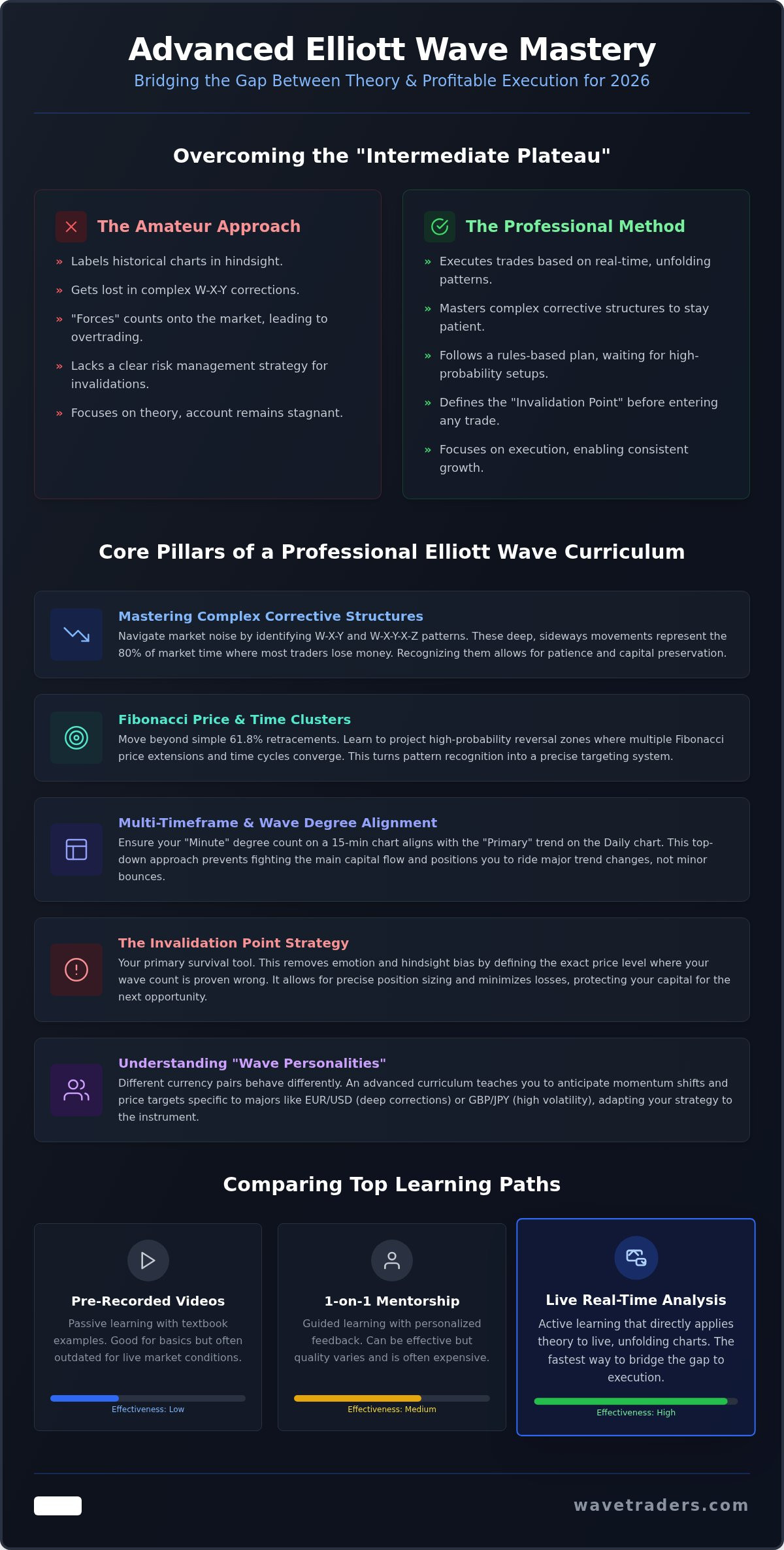
Most traders can label a perfect five-wave move on a historical chart, but very few can execute that same count in real-time while the candles are still forming. It’s a common frustration to master the basics of an Elliott Wave forex trading course only to feel lost when complex W-X-Y corrective structures appear on the live screen. You’ve likely experienced the sting of hindsight analysis where the count only seems to work after the profit opportunity has passed. It’s even more difficult when you lack a clear strategy for managing risk the moment a wave count is invalidated.
This guide promises to help you find an advanced curriculum that bridges the gap between theoretical counting and profitable execution. You’ll learn the critical criteria for selecting a course that turns complex patterns into a rules-based trading plan. We’ll explore how to master Fibonacci price and time clusters to improve your entries. We’ll also look at how professional wave theory can help you finally pass a funded trader program challenge. By the end, you’ll know exactly what to look for in a 2026 program that treats trading as a craft rather than a history lesson.
Many traders hit what we call the “Intermediate Plateau.” It’s that frustrating stage where you understand the basic Elliott Wave Principle, yet your account balance remains stagnant. You can identify a clear impulse on a historical chart, but the live markets feel like a chaotic mess of noise. In 2026, this challenge has intensified. High-frequency trading and algorithmic execution have increased intraday volatility, often distorting traditional patterns into complex, multi-layered structures. Real-time analysis now requires a deeper understanding of how these algorithms interact with human psychology.
Transitioning from “counting for fun” to “trading for income” requires a significant shift in perspective. An advanced Elliott Wave forex trading course doesn’t just teach you more obscure patterns. Instead, it provides high-probability filters to protect your capital. These filters help you distinguish between a tradable setup and a low-conviction environment where staying out of the market is the most profitable move.
Introductory materials often focus on textbook examples that rarely appear in the modern FX market. Basic impulse counts frequently fail in sideways forex markets because they don’t account for the “personality” of specific currency pairs. When you only know the basics, there’s a dangerous tendency to use “forced counts.” You see a pattern because you want to trade, not because the market structure supports it. This lack of depth often leads to overtrading during complex corrections. A trader might try to catch every minor wiggle, only to get chopped up by a W-X-Y structure they didn’t recognize until after the stop loss was hit. Without understanding wave degrees, it’s easy to get lost in the “noise” of lower timeframes while missing the primary trend.
Professional education moves you beyond the “what” of market movement and into the “why” and “when.” By developing a definitive rules-based framework, you can significantly reduce the psychological stress that comes with market uncertainty. You learn to wait for the market to confirm your bias through specific price and time clusters. An advanced course is a bridge between pattern recognition and capital management. Choosing a specialized Elliott Wave forex trading course in 2026 means investing in a methodology that prioritizes execution over theory. It’s about developing the discipline to ignore the noise and focus on the high-conviction zones where the risk-to-reward ratio is skewed heavily in your favor. This approach turns a theoretical hobby into a professional pursuit, much like how prospective lawyers use the specialized training of Jackson-Wagner LLC to successfully prepare for the rigors of the California Bar Examination.
A high-quality Elliott Wave forex trading course should prioritize market structure over simple counting. It needs to provide a framework for the 80% of the time the market spends in corrective phases. When selecting an Elliott Wave forex trading course, verify that the syllabus covers multi-timeframe alignment and specific execution rules. Without these, you are simply looking at shapes on a chart rather than identifying tradable opportunities.
Mastering W-X-Y and triple-three W-X-Y-X-Z structures is essential for the 2026 trader. These aren’t just academic curiosities; they represent the deep liquidity hunts often seen in major currency pairs like the Euro or Cable. Recognizing these complex patterns allows you to stay patient while others are stopped out by premature entries.
We must move beyond the standard 61.8% retracement to look for time-price clusters. This is a core component of the Chartered Market Technician (CMT) Program curriculum, emphasizing that price targets aren’t random. Using Fibonacci expansions helps you project where Wave 3 momentum might exhaust or where a Wave 5 might truncate.
You must align a “Minute” degree count on the 15-minute chart with the “Primary” trend on the daily. This top-down approach ensures you aren’t fighting the larger flow of capital. It’s the difference between catching a minor bounce and riding a major trend change.
The “Invalidation Point” strategy is your primary survival tool. It removes the ambiguity of “hindsight” analysis by defining the exact price level where your count is no longer valid. By knowing this level before you enter, you can calculate your position size accurately and minimize losses. This discipline is what separates professional practitioners from retail speculators.
Traders often struggle with the Elliott Wave triangle pattern during sideways regimes. Professional courses teach you to differentiate between Zigzags, Flats, and Irregular corrections. The “E” wave of a triangle is often the highest-reward opportunity because it marks the final stage before a breakout. Recognizing the sub-waves within these corrections helps you avoid the “choppy” price action that destroys smaller accounts.
Wave 3 and Wave 5 targets aren’t guesses. We use Fibonacci expansions like the 1.618 and 2.618 to project where momentum might exhaust. In expanded flat corrections, the 1.236 and 1.382 levels are critical for identifying where Wave B might end. Identifying “Golden Zones” where multiple wave degrees converge provides the highest probability for a reversal; this is where the market’s internal geometry aligns across different timeframes. These clusters offer a definitive edge in trade timing.
If you’re looking for real-time application of these pillars, our FX Service tracks these setups daily across the major currency pairs.
Choosing an Elliott Wave forex trading course isn’t just about the syllabus; it’s about how the information is delivered and applied. Most traders begin with static video courses. These are excellent for building a foundation because they’re self-paced and generally more affordable. However, they often rely on historical examples where the wave count is already settled. In the fast-moving 2026 market, a count that worked two years ago might not account for current liquidity shifts or high-frequency trading noise.
Live mentorship offers a more hands-on experience. You receive direct feedback and psychological coaching, which is invaluable when you’re struggling with execution discipline. The downside is that mentorship is often expensive and requires a rigid time commitment that doesn’t always align with a trader’s schedule. It’s a high-touch model that yields great results but isn’t accessible to everyone.
The hybrid model is emerging as the most effective choice for the modern trader. It pairs a structured Elliott Wave forex trading course with ongoing, real-time application. This approach allows you to learn the core rules on your own time while seeing those same rules applied to current market conditions. It effectively bridges the gap between theoretical knowledge and the practical Elliott Wave forex analysis required to survive in live markets. Active learning is the only way to keep up as market cycles shift and patterns evolve.
There’s a significant risk in learning only from “perfect” historical charts. Today’s EUR/USD price action rarely mirrors the clean textbook diagrams found in basic manuals. Real-time analysis services validate the lessons you learn by showing you how to handle market ambiguity as it happens. An effective wave theory trading course must include live chart updates to remain relevant. Without seeing how a count is adjusted when a level is breached, you’re only learning half the skill.
Before you commit your capital, use a strict checklist to evaluate your options. A professional program must cover wave degrees in detail and place a heavy emphasis on risk management. Look for a community where you can discuss counts with other practitioners. Watch out for red flags like “100% accuracy” claims or a lack of clear invalidation rules. If an instructor doesn’t tell you exactly where their count is wrong, they aren’t teaching you how to trade. It’s vital to learn from an active practitioner who trades the markets every day, rather than a lecturer who only looks at the past.
Forex markets in 2026 demand more than just a basic understanding of patterns. High-frequency algorithms and shifting liquidity pools have made the environment more challenging for retail participants. To stay ahead, you must understand that each currency pair exhibits a distinct “wave personality” that reflects its underlying economic drivers. For instance, GBP/USD often produces deeper, more complex corrections compared to the persistent, one-directional impulses frequently seen in USD/JPY. An advanced Elliott Wave forex trading course teaches you to adjust your expectations based on these specific behaviors rather than applying a one-size-fits-all approach.
Correlating your counts with the US Dollar Index (DXY) provides an extra layer of confirmation that basic courses often miss. If the DXY is completing a clear impulsive move, it’s highly likely that your counts on G10 majors are also reaching a point of exhaustion. This macro perspective helps you avoid “fighting the Fed” or entering a trade right as the broader dollar trend is about to reverse. Professional risk management also shifts away from arbitrary pip-based stops. Instead, you learn to set stops at the specific price level where the wave structure is mathematically invalidated, ensuring your exits are based on market logic rather than fear. Traders who want to understand how these wave-based signals compare to traditional trend-following methods will benefit from studying Elliott Wave vs Dow Theory to see why fractal analysis often identifies turning points before lagging indicators confirm the move.
The rise of prop firms has changed how retail traders approach the market. These programs impose strict drawdown rules that punish sloppy execution and emotional trading. The Wave Principle is uniquely suited for this environment because it identifies the high-conviction entries needed to pass funded challenges. Managing the “Daily Drawdown” limit becomes much easier when you use wave-based position sizing, allowing you to risk less during corrective phases and more during impulsive moves. Wave 3 entries are the primary target for meeting profit goals quickly, as they represent the strongest and most predictable part of any market trend.
Volatile pairs often experience “truncations” during high-impact news events, where Wave 5 fails to move beyond the end of Wave 3. You also have to account for central bank interventions, which can warp corrective structures and turn a simple zigzag into a complex irregular flat. Tracking the EUR/USD Elliott Wave analysis is the best way to master the world’s most traded pair while observing these dynamics. If you’re ready to apply these concepts to your own trading, consider joining our Funded Trader Program to put your skills to the test in a professional environment.
Finding the right Elliott Wave forex trading course is often the turning point in a trader’s career. At Wavetraders, we’ve built the Elliott Wave School to be more than just a collection of tutorials. It’s a practitioner-led curriculum designed to move you from theoretical counting to consistent, professional execution. Our approach recognizes that while the rules of the Wave Principle are timeless, the way they manifest in modern markets requires constant refinement. You aren’t just learning to label charts. You’re learning to read the intent of market participants across FX, indices, and digital currencies.
The synergy between our structured video lessons and our live FX Service is what sets this program apart. You’ll study the core concepts in the school and then immediately see those rules applied to the current 2026 market cycles. This live lab environment helps you internalize the nuances of wave personality and invalidation points discussed in previous sections. By tracking the markets alongside our professional analysts, you’ll develop the confidence to execute trades even when the price action feels uncertain. We don’t just provide a count; we explain the reasoning behind it so you can learn to do the same.
Our modules are comprehensive, covering everything from the fundamental rules to the most advanced W-X-Y-X-Z corrective structures. We believe that professional trading requires professional tools. That’s why our students receive access to the Elliott Wave Calculator. This proprietary tool simplifies the process of finding precise Fibonacci projections and retracements, allowing you to focus on pattern recognition rather than manual math. We also provide regular video updates that bridge the gap between static theory and real-time setups. These updates ensure that your Elliott Wave forex trading course stays relevant as market conditions evolve throughout the year.
Education without execution is simply a hobby. Our FX Service acts as the bridge that turns knowledge into capital management. Once you’ve mastered the curriculum, you can leverage our Funded Trader Program referral to put your skills to work with professional capital. This path offers a clear trajectory for those who want to trade for a living without risking their own savings. You’ll be part of a community of serious traders who share a common language and a common goal. Join us today and start your journey toward mastering the waves in a supportive, professional environment where education meets execution.
Mastering the market’s rhythmic cycles requires more than just a passing knowledge of basic five-wave moves. It’s about developing a disciplined, rules-based framework that accounts for the complex corrections and high-frequency noise of today’s environment. By focusing on wave degrees and definitive invalidation points, you can move beyond the frustration of hindsight and begin executing trades with quiet confidence. Success in 2026 isn’t about finding a perfect count every time; it’s about managing risk when the market remains ambiguous.
Choosing a professional Elliott Wave forex trading course is an investment in your future as a practitioner. At Wavetraders, we’ve provided practitioner-led education since 2003, ensuring our students learn from those who actually trade. Our curriculum isn’t taught in a vacuum. It’s integrated with real-time FX and Crypto analysis to show you how theory works in live markets. You’ll also gain exclusive access to the Elliott Wave Calculator to help find precise Fibonacci clusters without the guesswork.
The journey from a retail speculator to a professional trader is built on patient observation and refined skill. We invite you to Apply for the Wavetraders Elliott Wave School and Master the Markets. Let’s track these patterns together and turn the complexity of the waves into your greatest trading advantage.
Advanced training is often the missing link for traders who understand the basics but struggle with execution. While introductory materials cover simple patterns, they rarely explain how to handle the complex corrective structures found in live markets. A professional Elliott Wave forex trading course provides the rules-based filters needed to avoid low-probability setups. It helps you distinguish between tradable impulses and the sideways noise that often leads to unnecessary losses in a retail account.
Mastery typically requires six months to two years of consistent application. While you can learn the core rules and patterns in a few weeks, the skill lies in recognizing these structures as they form in real-time. This process involves observing multiple market cycles and learning how to adjust counts when price action becomes ambiguous. Deliberate practice on live charts is much more effective for long-term mastery than simply studying historical examples in a textbook.
You can apply the Principle to any timeframe because market patterns are fractal in nature. Scalpers often use wave theory on one-minute or five-minute charts to identify high-momentum impulses or the final stages of a correction. However, lower timeframes often contain more algorithmic noise. To maintain a high win rate, it’s vital to align your short-term setups with the trend of a larger degree, ensuring you aren’t scalping against the primary flow of capital.
Motive waves move in the same direction as the trend of one larger degree and consist of five distinct sub-waves. They represent the phases of the market where momentum is strongest and price moves most rapidly. In contrast, corrective waves move against the larger trend and typically form three-wave patterns or complex sideways structures. Distinguishing between these two allows you to identify whether the market is trending or simply consolidating before the next move.
Professional education costs vary depending on the delivery format and the level of personalized support provided. Static video modules are generally the most affordable option, while live mentorship programs represent the higher end of the market. In 2026, many traders look for hybrid models that balance structured lessons with ongoing market application. You should consider whether the price includes access to proprietary tools or real-time analysis before making a final decision on your education.
The Wave Principle applies to any liquid market where collective human psychology drives price action. While the specific volatility may differ, the underlying structures remain consistent across Bitcoin, Gold, or Crude Oil. Traders who complete an Elliott Wave forex trading course often find their skills are highly transferable to these other asset classes. The key is learning how to identify wave personality and Fibonacci clusters regardless of the specific instrument being traded in the market.
Advanced traders look beyond the standard 61.8 percent retracement to find precise price targets. We prioritize the 1.618 and 2.618 extensions for projecting the end of a third wave. For corrective patterns, the 1.236 and 1.382 levels are essential for identifying expanded flats. The most powerful signals occur at Fibonacci clusters, where multiple ratios from different wave degrees converge at a single price point. These zones offer the highest probability for a trend reversal.
Invalidation is a critical part of the methodology because it provides a definitive point where your trade thesis is proven wrong. When a news event causes a price move that breaks a key level, it’s a signal that the market has shifted or your count was incorrect. Rather than trying to force a new count during the volatility, you should step aside and wait for a new pattern to clarify. This discipline protects your capital during uncertain periods.
DISCLAIMER
Any reviews, news, analysis, prices or other information contained on our website is provided as general market commentary and delivered electronically through a distribution channel to larger number of clients, therefore does not constitute investment advice or investment research. We are not trading advisors. Most of our work is for educational purposes only, with information based on Elliott Wave theory in real time. Trading forex, futures, options, stocks, cryptocurrenices or any another trading market carries a high level of risk, and may not be suitable for all investors.
The possibility exists that you could lose some or all of your initial investment; therefore you should not invest money that you cannot afford to lose. Our website and the information that we provide should not be relied upon as a substitute for extensive independent research before making your investment decisions. In no event will we be liable for any loss or damage on your account in connection with, the use of our products. For any real cash investments you have to contact your financial advisor.
Any information or material contained on our website is owned by Val Global d.o.o.. Reproduction is prohibited without Val Global d.o.o. prior license in writing.
By continuing to use the site, you agree to the use of cookies. Learn more.
The cookie settings on this website are set to "allow cookies" to give you the best browsing experience possible. If you continue to use this website without changing your cookie settings or you click "Accept" below then you are consenting to this.