Precision in the forex market isn’t about predicting the future; it’s about measuring the present with enough accuracy to identify where the crowd is likely to turn. Many traders treat an Elliott Wave calculator for forex as a shortcut to wealth, but the experienced practitioner knows it’s actually a tool for managing probability. You’ve likely experienced the frustration of manual calculation errors or the confusion that sets in when you’re trying to decide which Fibonacci ratio fits a complex Wave 2 retracement while the market moves against you.
We understand that slow analysis in a fast-moving market leads to missed entries and eroded confidence. This guide will teach you how to master these calculators to project price targets and retracements with mathematical precision. You’ll learn a repeatable workflow for identifying the most lucrative Wave 3 and Wave C moves without the guesswork. By the end of this piece, you’ll know how to transform your chart analysis from a series of hurried estimates into a methodical, professional routine that highlights high-probability target zones with clarity.
An Elliott Wave calculator for forex is a specialized digital tool designed to apply Fibonacci ratios to specific market swing points. By inputting the start and end of a known wave, the tool projects potential future price levels based on historical mathematical probabilities. While the Elliott Wave principle is often discussed as a study of market psychology, the calculator translates that psychology into actionable data. It bridges the gap between theoretical pattern recognition and the hard numbers required for trade execution. Traders should distinguish between price-based tools, which focus on vertical targets, and time-based projections that attempt to predict when a move will conclude. Most practitioners prioritize price targets to define their risk and reward parameters.
In the 24/5 forex market, speed is a necessity. Currency pairs can move hundreds of pips during a single news release, leaving little time for manual calculations. A calculator provides rapid target identification, allowing you to react to price action as it happens. This speed doesn’t just help with entries; it’s vital for adjusting stop losses and take-profit orders in real time. When volatility spikes, having an automated way to verify your targets keeps you grounded in your strategy rather than reacting emotionally to the screen.
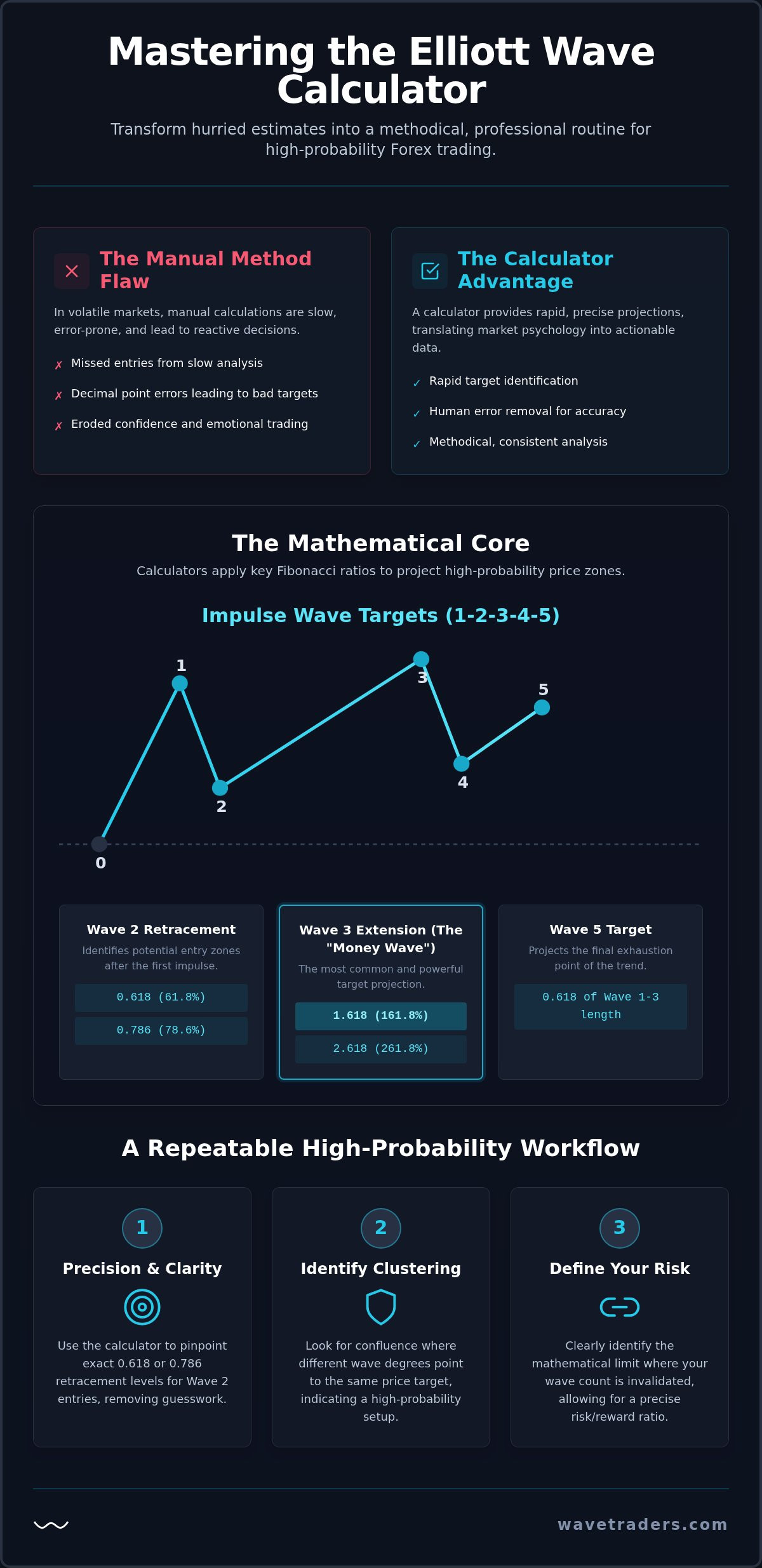
Manual calculation is prone to errors, especially when you’re trying to determine a 1.618 extension for a fast-moving Wave 3. A single decimal point mistake can lead to a missed trade or a premature exit. An Elliott Wave calculator for forex removes this human error factor. It doesn’t just give you a static number; it helps you visualize zones of interest. These zones represent areas where impulsive moves and corrective pullbacks are likely to find support or resistance, giving you a clearer picture than a single, isolated price point. This methodical approach ensures that your analysis remains consistent even when the market feels chaotic.
Standardizing your approach is the hallmark of a professional. Using a calculator allows you to apply the same rigorous criteria across multiple pairs, from EUR/USD to AUD/JPY. This consistency helps you identify clustering, which occurs when different wave degrees point toward the same price target. Finding this confluence is often the difference between a mediocre setup and a high-probability trade.
By knowing these limits, you can significantly improve your risk/reward ratio. You aren’t just guessing where a move might end. You’re trading based on the mathematical boundaries of the market structure, which provides a level of quiet confidence that manual charting rarely offers.
The mathematical foundation of wave analysis is built on the Fibonacci sequence. While some platforms suggest using default settings for every calculation, professional market applications of Elliott Wave Theory require a more nuanced understanding of which ratios apply to specific waves. An Elliott Wave calculator for forex simplifies this by pre-setting the most statistically significant levels for each move. This allows you to focus on the structure of the market rather than getting lost in a spreadsheet.
Most professional counts prioritize the golden ratio (1.618) as the primary target for impulsive moves. If the market is in a strong trend, the calculator helps you visualize these extensions as logical profit-taking zones. Recognizing these mathematical boundaries early is what separates a prepared trader from one who is simply chasing price action.
While Wave 3 takes the spotlight, Wave 1 sets the initial pace. Calculating the typical 161.8% extension for a powerful third wave is the most common use of the tool. If price surges past this level, the 2.618 extension becomes the next probable target. To find the exhaustion point of Wave 5, we often measure the distance from the start of Wave 1 to the end of Wave 3, then project a 61.8% extension from the end of Wave 4. In major currency pairs, the rule of thumb is that only one of the three impulse waves (1, 3, or 5) will be significantly extended. Using an Elliott Wave calculator for forex helps you track these extensions without losing focus on the broader market structure.
Identifying the end of a correction is often more difficult than finding the peak of an impulse. In a Zigzag correction, Wave C often reaches equality with Wave A, which is the 100% projection. If the market is more volatile, the 123.6% or 161.8% levels become the primary targets. When measuring the depth of Wave B in an expanded flat, the calculator might show an extension of 1.236 or 1.382 beyond the start of Wave A. This mathematical boundary is crucial for maintaining an objective count, as it prevents you from forcing a pattern onto a chart that no longer fits the established rules. The tool will often identify an invalid count if Wave 2 retraces more than 100% of Wave 1, saving you from a potentially costly mistake. If you’re looking to see these mathematical principles applied to live charts, you can explore the analysis provided in our FX service.
The principle of alternation also plays a role here. If Wave 2 was a sharp, deep retracement (like 0.618), the calculator helps you prepare for a shallow, sideways Wave 4 (like 0.236 or 0.382). This relationship ensures your strategy remains balanced and accounts for the different ways the market corrects itself over time. The same Fibonacci principles that govern currency pairs also apply to commodities, as demonstrated by our silver Elliott Wave analysis, where corrective structures following a historic surge reveal the universal nature of these mathematical patterns.
Choosing an Elliott Wave calculator for forex often involves a trade-off between speed and control. While the market offers various tools, from simple web-based forms to complex automated indicators, the most effective method depends on your experience level and trading style. Professional traders generally view these calculators as assistants rather than replacements for their own judgment. The goal isn’t just to get a number, but to arrive at a target that makes structural sense within the broader market context.
Identifying the initial impulsive move and the subsequent corrective pullback manually creates a psychological connection to the chart. When you use a manual Elliott Wave calculator for forex, you’re forced to verify the starting points of Wave 1 and Wave 2. This deliberate process ensures that your count respects the fundamental “Rule of Three,” which dictates that Wave 3 can never be the shortest of the three impulse waves. Manual input also provides the flexibility to adjust for market noise. On lower timeframes, currency pairs often produce anomalous price spikes during news events. A manual approach allows you to filter these out, focusing on the true structural highs and lows rather than being misled by temporary volatility.
Purely automated software promises a “set it and forget it” experience, but it often struggles with the nuances of the forex market. One common issue is how algorithms interpret price wicks versus candle bodies. During high-impact data releases, a long wick might be a liquidity grab rather than a structural shift. Automated tools frequently mislabel these points, leading to inaccurate projections. This can result in entries that ignore the underlying momentum of the move.
Semi-automated scripts offer a practical middle ground. These tools allow you to select the specific anchor points on your chart while the software handles the complex Fibonacci extensions and retracements. This balance provides algorithmic precision without sacrificing your analytical perspective. For high-stakes counts, the ability to oversee the input process is often what separates a successful trade from a stopped-out position. By maintaining human oversight, you ensure the calculator serves your strategy rather than dictating it.
Moving from theoretical pattern recognition to actual trade execution requires a disciplined, repeatable workflow. An Elliott Wave calculator for forex is most effective when you follow a structured sequence of inputs. This process removes ambiguity. It ensures that your entries are based on market structure rather than emotional impulses. By using a calculator, you can quickly determine if a setup offers a high enough reward to justify the risk before you ever place a trade.
Consider the current EUR/USD Elliott Wave analysis as a practical foundation for your math. If you identify a Wave 1 impulse that spans 100 pips and Wave 2 retraces exactly 50% of that move, your calculator will project the Wave 3 target. A standard 161.8% extension would place the target 161.8 pips above the Wave 2 low. Within this larger move, you can use the calculator to identify smaller sub-waves. This granularity allows you to scale into the position as the internal structure confirms your primary thesis. Using an Elliott Wave calculator for forex in this way helps you avoid the common mistake of exiting a winning trade too early.
A calculator helps you find the point of no return where a specific count is no longer valid. This is usually the start of Wave 1 for an impulsive setup. As the trade progresses and the calculator projects the completion of Wave 4, you can adjust your stops to lock in gains. The breakeven point is typically established once price clears the peak of Wave 2, as this confirms the trend has transitioned into the heart of the third wave. To start applying these steps to your own charts, you can access our professional Elliott Wave Calculator in the member area.
Mastering the markets requires more than just a digital interface. While an Elliott Wave calculator for forex is an essential component of a modern toolkit, its true power is unlocked when paired with professional guidance. At Wavetraders, we’ve built an ecosystem where the math meets the method. Our tools are designed by practitioners who understand that a Fibonacci extension is just one piece of a much larger puzzle. By seeing how seasoned analysts identify the start of a trend, you can validate your own inputs and ensure your calculator settings align with the broader market structure. This collaborative approach turns a solitary task into a professional routine.
A calculator provides the price levels, but market sentiment often dictates the timing of a move. The Wavetraders FX Service offers real-time analysis that bridges this gap. Instead of analyzing in a vacuum, you can compare your projections with daily wave count updates for major currency pairs. This context helps you determine if a move is a standard impulse or a complex corrective structure. Engaging with our community also refines your pattern recognition skills. It allows you to track the markets together, sharing observations and learning from the collective experience of a team that has been active since 2003.
If you want to move beyond simply using a tool and start mastering the methodology, the Elliott Wave School provides a structured path. Understanding the underlying psychology of wave patterns is ultimately more profitable than just following a set of numbers. Our curriculum is designed to take you from a curious hobbyist to a trader capable of managing significant capital through our Funded Trader Program. We focus on the “why” behind every market move. This gives you the intellectual honesty to acknowledge uncertainty while maintaining the confidence to execute your plan. This comprehensive approach ensures that you aren’t just reacting to price; you’re anticipating it with a professional-grade Elliott Wave calculator for forex in your arsenal.
Apply for a Wavetraders membership today and access our full suite of analysis tools.
Integrating an Elliott Wave calculator for forex into your daily routine transforms analysis from a subjective exercise into a disciplined, data-driven workflow. By relying on established Fibonacci ratios and avoiding manual calculation errors, you gain the clarity needed to identify high-probability targets in the fastest-moving currency pairs. However, the tool is only as effective as the trader’s understanding of the underlying market structure. Moving from simply identifying waves to mastering the logic behind them is the hallmark of a professional practitioner.
Since 2003, we’ve provided the expert analysis and educational framework necessary to navigate volatile markets with composure. Whether you’re tracking real-time moves in FX, crypto, or commodities, our structured approach ensures you aren’t just following a chart, but interpreting a story. We invite you to join a community of dedicated practitioners who prioritize precision over hype.
Start Your Professional Elliott Wave Education at Wavetraders and access our comprehensive Elliott Wave School curriculum today. We look forward to tracking the markets with you and helping you build a repeatable, confident approach to technical analysis.
The most accurate calculator is one that allows for manual input of specific swing points rather than relying on fully automated black-box algorithms. Accuracy in the forex market depends on the trader’s ability to identify the correct starting points for Wave 1 and Wave 2. A professional-grade Elliott Wave calculator for forex serves as a precision measurement tool for these inputs. It ensures that the Fibonacci extensions are applied consistently without the risk of manual calculation errors.
You can use these calculators for 1-minute scalping, but the reliability of the wave patterns decreases on extremely low timeframes due to market noise. While the math remains the same, price action on a 1-minute chart is often influenced by minor liquidity shifts and spread fluctuations. Most professional practitioners prefer to identify the primary trend on a higher timeframe, such as the 1-hour or 4-hour, and then use the calculator to find entries on the lower timeframes.
To calculate a Wave 3 target, you measure the length of Wave 1 and project a 1.618 extension from the end of Wave 2. This level is the most common target for a standard impulse move. If the momentum is particularly strong, the calculator may also highlight the 2.618 extension as a secondary zone of interest. Identifying these levels early allows you to set objective profit targets and manage your risk/reward ratio with greater confidence.
Yes, the Elliott Wave calculator for forex works on all currency pairs because the underlying Fibonacci ratios reflect universal patterns of human psychology. Whether you’re trading major pairs like EUR/USD or more volatile crosses like GBP/JPY, the mathematical relationships between impulsive and corrective moves remain consistent. However, you’ll often find that the cleanest wave structures appear in pairs with high liquidity where the crowd behavior is more clearly defined.
A standard Fibonacci tool measures simple retracements or extensions, whereas an Elliott Wave calculator is pre-set with specific ratios that apply to the rules of wave theory. While a general tool might show every possible level from 0.236 to 4.236, a specialized calculator focuses on high-probability targets for specific moves. This specialization helps reduce chart clutter and streamlines your decision-making process during live trading by highlighting the levels that matter most to the current count.
There are free Elliott Wave calculators available, including basic web-based tools and the free charts offered by many analysis services. Beginners can use these free versions to practice identifying swing points and calculating basic targets. As you progress toward professional trading, you’ll find that integrated toolkits provide more advanced features like multi-degree tracking and real-time validation against expert counts, which are essential for navigating complex market cycles.
When a move exceeds the 1.618 ratio, you should look toward the 2.618 or 4.236 extensions as the next logical targets for an extended Wave 3. Extensions are common in the forex market, particularly during strong fundamental shifts. If the calculator shows price pushing past the initial target with high momentum, it’s often a sign that you’re in an extended wave. In these cases, it’s prudent to trail your stop loss rather than exiting the position entirely.
If price hits a mathematical target but the internal sub-wave structure appears incomplete, the market may be heading toward a deeper extension. Ratios provide a map of probability, not a guarantee of reversal. You should always look for a confluence of factors, such as momentum divergence or a completed five-wave sub-structure, before concluding that a move is over. The calculator identifies the where, but the internal wave count often tells you the when.
DISCLAIMER
Any reviews, news, analysis, prices or other information contained on our website is provided as general market commentary and delivered electronically through a distribution channel to larger number of clients, therefore does not constitute investment advice or investment research. We are not trading advisors. Most of our work is for educational purposes only, with information based on Elliott Wave theory in real time. Trading forex, futures, options, stocks, cryptocurrenices or any another trading market carries a high level of risk, and may not be suitable for all investors.
The possibility exists that you could lose some or all of your initial investment; therefore you should not invest money that you cannot afford to lose. Our website and the information that we provide should not be relied upon as a substitute for extensive independent research before making your investment decisions. In no event will we be liable for any loss or damage on your account in connection with, the use of our products. For any real cash investments you have to contact your financial advisor.
Any information or material contained on our website is owned by Val Global d.o.o.. Reproduction is prohibited without Val Global d.o.o. prior license in writing.
By continuing to use the site, you agree to the use of cookies. Learn more.
The cookie settings on this website are set to "allow cookies" to give you the best browsing experience possible. If you continue to use this website without changing your cookie settings or you click "Accept" below then you are consenting to this.