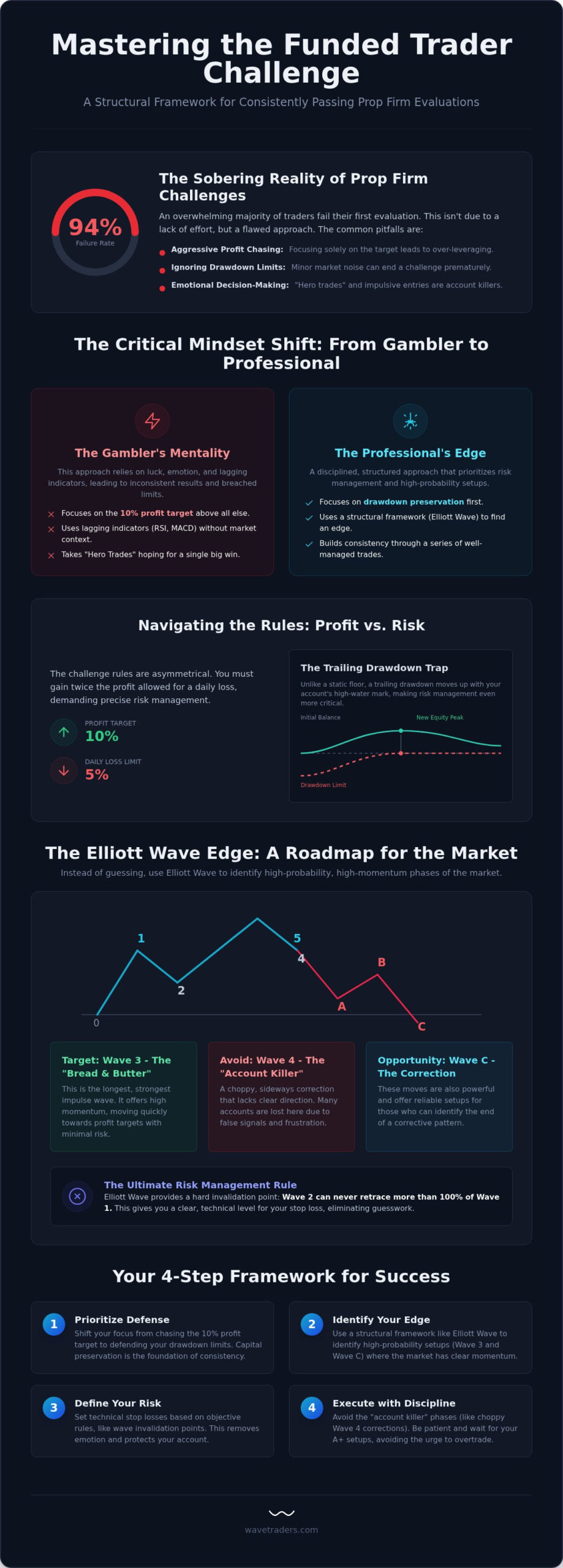
Did you know that nearly 94% of traders fail to complete their first evaluation phase? It’s a sobering statistic that highlights the difficulty of balancing aggressive profit targets with razor-thin drawdown limits. Most people searching for how to pass funded trader challenge focus almost exclusively on hitting that 10% profit target as quickly as possible. This approach usually leads to overtrading, emotional decision-making, and eventually, a breached daily loss limit caused by minor market noise.
We understand the frustration of seeing a promising account vanish because of a single impulsive trade or a lack of a clear structural edge. It’s exhausting to chase targets while feeling like the market is moving against your specific rules. This guide will help you master the structural analysis and risk management framework needed to clear prop firm evaluations consistently. By applying a disciplined methodology, you can transition from a gambling mentality to a professional trading mindset.
We’ll preview the specific Elliott Wave strategy for 2026, focusing on how to identify high-probability Wave 3 entries that offer the 1:3 reward-to-risk ratios required for success. You’ll learn how to navigate the mature market structures of the current year while keeping your account equity safely away from the maximum drawdown boundaries.
The statistical reality of prop firm evaluations is daunting. Industry data suggests that nearly 95% of participants fail to reach the funded stage. This high attrition rate isn’t usually due to a lack of effort. Instead, it stems from a fundamental misunderstanding of the mathematical hurdles and psychological pressures inherent in the challenge structure. When you are researching how to pass funded trader challenge, you must first confront the asymmetry of the rules. A typical evaluation requires a 10% profit target but allows only a 5% daily drawdown. This means you must generate twice as much profit as the risk you are permitted to take on any given day.
Many traders rely on lagging indicators like RSI or MACD to find entries. While these tools can work in trending markets, they often provide false signals during the low-volatility, corrective phases that dominate much of the trading week. Without the structural context provided by the Elliott Wave Principle, a trader is effectively flying blind. They see a “buy” signal on an oscillator without realizing they’re actually entering at the tail end of a corrective B-wave. This lack of situational awareness leads to trades that move against the user almost immediately, eating into the tight drawdown limits.
Drawdown limits are the most frequent cause of failure. A static drawdown is based on the initial balance, giving you a fixed floor. However, many modern firms use a trailing drawdown. This rule is significantly harder because the “floor” moves up as your account equity reaches new peaks. If you hit a $2,000 profit and then suffer a $1,500 retracement, you might breach the trailing limit even if your account is still in profit. To survive this, you must adjust your position sizing downward as you approach your drawdown floor. Most traders fail in the first three days because they trade with maximum leverage before establishing a “profit cushion.”
The pressure of hitting a 10% target often leads to the “Hero Trade” mentality. This is the dangerous belief that you can clear the entire challenge in a single, high-leverage position. In reality, passing is a game of probability. To hit a 10% target with a 1:2 reward-to-risk ratio, you only need five successful trades more than your losing ones. Prop firms value consistency over raw profit. They aren’t looking for gamblers who get lucky once; they want professionals who can manage risk through a series of structured setups. Transitioning from a retail gambler to a funded professional requires you to stop chasing the target and start defending the drawdown.
Successful prop trading requires more than just a high win rate. It demands a structural roadmap that tells you exactly when to push and when to sit on your hands. Elliott Wave provides this by categorizing market movement into repetitive patterns. When you’re trying to figure out how to pass funded trader challenge phases, the most critical skill is identifying “motive” waves. These are the impulsive moves that travel quickly toward your profit target without threatening your drawdown limit. Unlike lagging indicators, wave theory looks at the underlying psychology of the market to predict where price is likely to go next.
The power of the strategy lies in Wave 3. This is typically the longest and strongest part of a market trend. Because Wave 3 is characterized by high momentum, it offers the best opportunity to hit a 10% target with minimal “heat” on the position. By focusing only on these high-conviction expansions, you can learn how to pass funded trader challenge requirements without the stress of constant monitoring. You’ll also stay out of Wave 4, which is usually a sideways, choppy correction. Most traders blow their accounts in Wave 4 because they try to trade a trend that has temporarily stalled and lost its directional conviction.
Many people think wave counting is purely subjective, but the core rules provide absolute clarity. For example, Wave 2 can never retrace more than 100% of Wave 1. This isn’t just a guideline; it’s a hard invalidation point. If price breaks that level, your thesis is wrong and you must exit immediately. This eliminates the “hope” factor that often leads to catastrophic losses. By following a rules-based system like the one taught at our Elliott Wave School, you develop the discipline to accept a small technical stop rather than a large daily limit breach. It’s about trading the reality of the chart, not your desire to pass the evaluation.
Timing your entries is just as important as identifying the trend. While some market risks are highlighted in regulatory notices, such as FINRA obligations for low-priced securities, the structural risks of volatility apply to every trader. Wave theory helps you predict expansion and contraction phases. This allows you to time your challenge entries when momentum is most likely to accelerate. Elliott Wave works best on the 1H and 4H timeframes. These periods are slow enough to filter out noise but fast enough to clear an evaluation. Combining wave counts with Fibonacci levels allows for precision entries. If you need a second pair of eyes on these setups, our FX Service provides the real-time analysis needed to stay disciplined.
Passing an evaluation isn’t just about survival; it’s about identifying the specific structural moments where the market is most likely to move in your favor. While many traders focus on high-volatility instruments like Gold (XAUUSD) or the Nasdaq (US100) because of their potential for large moves, they often lack a clear plan for entry. These assets are excellent for a funded challenge because they tend to adhere strictly to Elliott Wave patterns. This provides the high-momentum moves required to reach profit targets within the necessary risk parameters of your evaluation.
The most reliable setup for any trader wondering how to pass funded trader challenge phases is the transition from a corrective Wave 2 into an impulsive Wave 3. This is our “Bread and Butter” trade. Because Wave 3 is the strongest part of the cycle, it provides the directional conviction needed to clear a 10% profit target without the account lingering in drawdown for days. By focusing on these specific expansions, you avoid the frustration of being stopped out by minor market noise during sideways price action.
Spotting the impulsive start of a third wave requires patience. You look for a five-wave move up (Wave 1) followed by a shallow, three-wave correction (Wave 2). The entry occurs as price breaks the peak of Wave 1, confirming the trend. We typically set our primary profit targets at the 1.618 Fibonacci extension of Wave 1. This level is mathematically significant and often where the strongest momentum occurs. By capturing this specific move, you can hit your evaluation targets with fewer trades and lower overall leverage.
If you aren’t in a trending market, you can still find high-probability opportunities within corrective structures. The Wave C of an A-B-C flat correction is a perfect short-term target. Wave C is impulsive in nature, meaning it moves quickly toward its destination. Trading this leg allows you to secure gains while other traders are still confused by the sideways price action. However, you must be careful to avoid complex “W-X-Y” corrections, which can drag on and erode your equity. Using a professional FX Service to confirm your wave counts ensures you aren’t entering a trap correction.
In addition to Wave 3 and Wave C, keep an eye out for “Ending Diagonals.” These patterns appear at the end of mature trends, such as the current mature Wave 5 in the S&P 500. They signal an imminent and sharp reversal. Identifying an Ending Diagonal allows you to enter at the very start of a new trend. This offers the massive reward-to-risk ratios that can help you understand how to pass funded trader challenge requirements in a single, well-timed move without breaching your daily loss limits.
Mastering technical patterns is only half the battle. If you want to know how to pass funded trader challenge evaluations, you must align your market analysis with the rigid math of prop firm drawdown rules. Most traders approach risk as an afterthought, but in a challenge environment, your risk management framework is the only thing standing between you and a breached account. We recommend a systematic, five-step process to protect your equity while you hunt for Wave 3 expansions.
First, define your ‘Hard Stop’ based on the daily loss limit. If your limit is 5%, your personal daily exit should be at 4% to account for potential slippage or spread widening. Second, use Elliott Wave invalidation levels to set your technical stop loss. A Wave 2 must never retrace 100% of Wave 1; that specific price level is your objective exit. Third, calculate your position size so that hitting a technical stop never costs more than 0.5% of your total equity. This conservative approach allows you to survive a string of losses without hitting the daily limit. Fourth, implement a ‘Two-Loss Rule’ where you walk away for the day after two consecutive stop-outs. Finally, only scale into positions once the first leg is risk-free with the stop moved to break-even.
The key to longevity is ensuring your technical stop is always tighter than the prop firm’s daily limit. By using Elliott Wave Risk Management, you can place stops at levels where the market structure proves your count is wrong. This is far superior to using arbitrary pips or dollar amounts. The math of recovery is unforgiving. A 5% loss requires a 5.26% gain to recover, but a 10% loss requires an 11.1% gain. By keeping your losses small, you prevent the mathematical death spiral that ends most challenges. If you find yourself struggling with these calculations, our Funded Trader Program provides the support needed to stay within these bounds.
Handling a losing streak is the ultimate test of a trader’s discipline. It’s easy to fall into the trap of revenge trading to quickly make back a loss, but this almost always leads to a daily limit breach. Professional traders focus on the plan rather than the P&L. Even as an evaluation deadline might seem to approach, maintaining a methodical pace is essential. The market doesn’t care about your time limits. By staying focused on the structural setups we’ve discussed, you can navigate the drawdown without the emotional volatility that leads to failure. It’s about being a practitioner who respects the process and understands that how to pass funded trader challenge phases is a marathon, not a sprint.
Navigating a prop firm evaluation is often a psychological marathon. It’s easy to let bias cloud your judgment when you’re close to a profit target or hovering near a drawdown limit. This is why having a professional wave count as a second opinion is a critical part of your strategy. By leveraging our FX Service, you gain access to real-time analysis that keeps your counts grounded in structural reality. This objective perspective is often the deciding factor in how to pass funded trader challenge phases without succumbing to emotional overtrading.
The Elliott Wave School provides the foundational knowledge needed to identify high-probability setups independently. It’s the training ground where you learn to spot the patterns that prop firms can’t beat. When you understand the structural reason behind a move, you’re less likely to panic during a standard correction. We also provide a direct path for those ready to scale. You can apply for a partner discount on our Funded Trader Program, which currently offers a 30% reduction in fees to help you access larger capital more efficiently.
Your toolkit must include precision instruments that go beyond basic charting software. Our Elliott Wave calculator and real-time charts allow you to project Fibonacci extensions and retracements with mathematical accuracy. If you’re still deciding on a provider, comparing the Best Elliott Wave Analysis Services will show you that the depth of analysis matters more than the frequency of alerts. Joining a community of seasoned professionals ensures you’re tracking market cycles alongside practitioners who have decades of experience in these specific patterns.
Securing a funded account is only the beginning. The real challenge is keeping it. Developing the long-term habits of a professional practitioner is what leads to consistent, repeatable payouts. For many serious traders, an Elliott Wave subscription is worth it because the primary ROI comes from the drawdown you avoid. Our approach is built on the practitioner-teacher model. We share our passion for the methodology to help you understand how to pass funded trader challenge requirements while building a sustainable career in the markets. Success comes from respecting the wave structure and maintaining the discipline to wait for the high-conviction setups.
Passing an evaluation is a significant milestone that requires both a structural edge and ironclad discipline. You’ve learned that the secret to how to pass funded trader challenge phases lies in identifying high-probability Wave 3 expansions while strictly defending your daily drawdown. By aligning your technical stop losses with market invalidation levels, you move away from the gambling mentality that plagues most retail participants. You now have a roadmap to navigate the 2026 markets with confidence and precision.
Wavetraders has provided expert analysis since 2003, helping traders find their footing in volatile environments. Whether you’re tracking real-time FX and Crypto wave counts or looking for a structured learning path, we are here to support your journey. You can even take advantage of our current 30% discount on partner Funded Trader Programs to reduce your entry costs. The transition from a struggling trader to a funded professional is possible when you have the right tools and a community of practitioners by your side.
Pass your next challenge with the Elliott Wave School and start trading with the capital you deserve. We look forward to tracking the markets together.
You should risk no more than 0.5% of your equity per trade to ensure you don’t breach your daily limit. This conservative approach allows you to survive a string of losses without hitting the standard 5% daily drawdown cap. By keeping your risk low, you preserve your capital and stay in the game long enough to catch the high-momentum Wave 3 expansions that define how to pass funded trader challenge phases.
Elliott Wave is highly effective for day trading when applied to the 1H and 15M timeframes. While the patterns are fractal and appear on all charts, day traders often hunt for Wave 3 or Wave C moves to capture quick intraday momentum. This systematic approach provides a clear roadmap, helping you avoid the market noise and choppy price action that often stop out retail traders who rely on lagging indicators.
High-volatility assets like Gold (XAUUSD) and the Nasdaq (US100) are often the best instruments for clearing targets quickly. These assets tend to follow clean impulse waves and provide the expansion needed for high reward-to-risk ratios. However, you must be precise with your wave counts. Their inherent volatility can lead to fast daily limit breaches if your entry is poorly timed or your position sizing is too aggressive.
Your account will be failed immediately. Prop firms treat the daily loss limit as a hard stop to protect their capital from emotional or impulsive trading. Even if your total account balance remains well above the maximum drawdown level, breaching the daily limit of 5% is a violation of the evaluation rules. This is why mapping your technical stops to your daily equity protection is the most critical skill to master.
You must check your specific firm’s rules regarding news trading, as some prohibit opening or closing positions during high-impact releases. Even if it is permitted, the erratic price action can easily breach your daily limit through slippage or spread widening. We typically suggest staying flat during major data releases and waiting for a clear post-news wave structure to emerge before you commit any capital to a new position.
Many prop firms in 2026 have moved toward unlimited time limits, which removes the pressure of a 30-day window. Even under traditional constraints, Elliott Wave identifies fast-moving Wave 3 expansions that can hit a 10% target in a single trending week. The methodology focuses on quality over quantity, which is the most reliable way to understand how to pass funded trader challenge requirements without the stress of overtrading.
Most prop firms allow technical indicators and expert advisors (EAs) as long as they don’t involve prohibited strategies like latency arbitrage or certain types of grid trading. Using an automated tool to assist with wave counts or Fibonacci projections is generally acceptable and can help remove emotional bias. Always verify the trading conditions section of your firm’s fine print before you deploy any automated system on your evaluation account.
Overconfidence and a lack of consistency are the primary reasons traders fail the second phase. After hitting the larger 10% target in Phase 1, many traders relax their discipline or take larger risks to clear the smaller Phase 2 target quickly. This shift in mindset leads to impulsive decisions and a breach of the daily limit. Success requires maintaining a professional, methodical approach throughout every stage of the evaluation process.
DISCLAIMER
Any reviews, news, analysis, prices or other information contained on our website is provided as general market commentary and delivered electronically through a distribution channel to larger number of clients, therefore does not constitute investment advice or investment research. We are not trading advisors. Most of our work is for educational purposes only, with information based on Elliott Wave theory in real time. Trading forex, futures, options, stocks, cryptocurrenices or any another trading market carries a high level of risk, and may not be suitable for all investors.
The possibility exists that you could lose some or all of your initial investment; therefore you should not invest money that you cannot afford to lose. Our website and the information that we provide should not be relied upon as a substitute for extensive independent research before making your investment decisions. In no event will we be liable for any loss or damage on your account in connection with, the use of our products. For any real cash investments you have to contact your financial advisor.
Any information or material contained on our website is owned by Val Global d.o.o.. Reproduction is prohibited without Val Global d.o.o. prior license in writing.
By continuing to use the site, you agree to the use of cookies. Learn more.
The cookie settings on this website are set to "allow cookies" to give you the best browsing experience possible. If you continue to use this website without changing your cookie settings or you click "Accept" below then you are consenting to this.